Search results 226 Found
1909 - 1921 + 1949 SUPER GROUP OF ORIGINAL MANUSCRIPT DIARIES HAND WRITTEN BY A YOUNG MAN [7] AND ONE BY HIS NOTED FATHER AND FOUNDER OF THE UNIVERSITY OF TULSA
1909 - 1921 + 1949 SUPER GROUP OF ORIGINAL MANUSCRIPT DIARIES HAND WRITTEN BY A YOUNG MAN [7] AND ONE BY HIS NOTED FATHER AND FOUNDER OF THE UNIVERSITY OF TULSA
WILLIAM ROBERT KING Jnr. and Snr.
- Date published: 1909
MISSOURI ; ILLINOIS; TENNESSEE. Good. 1909. On offer is a collection of 8 diaries, the earliest is of 1909, 7 diaries are for the period from 1916 to 1921, and the last one is of 1949. Diaries of 1909, 1921, and 1949 have 60 pages each, diaries for 1916 through 1919 are 91 pages each, diary of 1920 is 365 pages and the record book is 152 pages. All diaries are in good condition and 100% complete, except the record book which is 90% complete. The author of 7 of these diaries was William Robert King Jr. of St. Louis, MO. He was the son of William Robert King, a Presbyterian minister and founder of Henry Kendall College, now the University of Tulsa. King Sr. was married and he and his wife had one child - a son also named William Robert King. A reference in the second diary notes King Sr.'s birthday which coincides with other records. A second reference (Sept 1, 1919) records his 24th birthday indicating he was born in 1895. This accords with his and his family's history. William Robert King Jr. was a graduate of Monmouth College and post-graduate in chemistry from the University of Illinois. He worked at the university for a while as an instructor of chemistry, then as a chemical engineer, and was connected with the National Carbide and Chemical Company in Cleveland. The first diary in the collection is written in 1909. It does not appear to have been written by King Jr. The age and experiences of the writer do not match up. The unknown author appears to be teaching in a high school as well as working as a minister: "... Second election for high school [ ]. Disqualified election and serious mistake in the counting ..." [Feb 19, 1909]. He probably writes about elections of school students for a trip to Washington as guests of Post-Dispatch, a major St. Louis newspaper, to see inauguration of President Taft, that were held in February of that year. "Preached this morning on John 1:46 ..." [Feb 28, 1909]. A great many entries referred to him studying but the specifics are not mentioned: "... Studying in A.M. Teachers meeting [ ] at College" [May 31, 1909]. This could in fact belong to King's father, Rev. William Rober King Sr. For part of his career, King served as superintendent of the American Sunday School Union's southwestern office in St. Louis, Missouri. The second diary definitely belongs to King Jr. as he has entered his name in the ID page. Written in 1916, he is attending high school in St. Louis. His entries are filled with references to classes, assignments and family: "Assigned to make up Physics and French exams in March. English Class: 9 - 10' French Class: 10 - 11' Economics Class: 12 - 1" [Feb 5, 1916]; "History lecture. Took French make-up exam - complete failure suppose it means I quit school as I cannot get credit on anything unless I have French ... " [Mar 31, 1916]. In fact, he does graduate and attends in Monmouth College in Monmouth, Ill. He was involved with his church and often participated in activities there: "... Taught class, communion services. Led C.E. consecration services, subject: consecration of time Ps 90: 1-17, Illustrated lecture on Philippines ..." [Apr 2, 1916]. He mentions a number of landmark buildings in St. Louis including the New Central Theatre and the Jefferson Hotel. He also references the 1916 presidential elections: "... race of Wilson and Hughes doubtful ..." [Nov 6, 1916]; " ... Election Wilson vs Hughes at 2 A.M. looks like Hughes Republicans carried Ill" [Nov 7, 1916]; "Election still doubtful looks like Wilson" [ Nov 8, 1916] "... election still doubtful ... claiming fraud" [Nov 9, 1916]; "Wilson seems elected Hurrah! ..." [Nov 10, 1916]. Amongst the many people he references is a girl referred to only as "M". The third diary, 1917, continues with his college life. "M" is still very much a part of it. "M" in fact is 'Marjorie' (Marjorie Scott) who becomes frequently referred to in later years. Eventually, they become engaged and married. WWI is indirectly referenced as well: "... company organized in college to drill every night ... " [Apr 11, 1917]; "... Situation getting critical quickly ... college presidents considering disbanding schools and giving whole time to military training" [Apr 14, 1917]. Throughout the year, he keeps track of his classes and comments on assignments and marks. He is in frequent communication with his father and mother. The fourth diary in 1918 sees him still at Monmouth College. He references the sensational Dawson trial in which John Wesley Knight, a 35-year-old black man, was sentenced to 19 years in Joliet penitentiary for the slaying of William E. Dawson; his wife, Charity and their daughter, 13-year-old Georgia: "Dawson trial most of A.M. State vs John Knight ..." [Jan 29, 1918]; "Down at trial in A.M. ..." [Jan 31, 1918]; "... Dawson trial went to jury ..." [Feb 1, 1918]; "... jury convicted Knight - 19 years ..." [Feb 2, 1918]. Extensive contemporary research suggests that the Dawson murder was the work of a German serial killer named Paul Mueller who travelled the country by rail killing perhaps as many as 100 Americans before returning to Europe, where he may have continued his spree. For those killings, the authors contend that four innocent people were executed, seven were killed by lynch mobs and four - including John Knight-served prison sentences. ?In August, he notes a very special date: "... Red Letter Day. M promised to be my wife" [Aug 28, 1918]. The fifth diary (1919) sees him continue his education at Monmouth. He also becomes a member of Tau Delta Phi ( ) and mentions their activities frequently. ??? He notes president Wilson's visit to St. Louis: "President Wilson in city today speaking tour for League of Nations ..." [Sept 5, 1919]. The sixth diary (1920) sees him continuing his education, at the University of Illinois at Champaign. Most of his entries revolve around university classes, activities with friends and family and his relationship with Marjorie. In December, he takes a major step: "Marjorie and I married by Dad at 10 A.M in church ..." [Dec 28, 1920]. The seventh (1921) continues with his university education and his married life with Marjory. He is working, at least part time and Marjory is working full-time: "M is teaching class often girls for Mrs. Camp this summer ..." [July 10, 1921]; "... notice of appointment as graduate associate in chemistry from Board of Trustees ..." [Aug 8, 1921]; He finishes the year working as an associate at the university in the field of Chemistry. The eighth diary (1949) is part of the collection but was not authored by William Robert King. Records suggest that King died in 1939 at the age of 44. It might have been authored by William Robert King, Sr., who after retirement and until his death in 1951 lived on his farm Church Hill near Kingsport. There are references to Kingsport, TN where both King Sr. & King Jr. are buried: "Good day in old Kingsport …" [Dec 18, 1949]. A number of references are agricultural: "Repairing barn." [Feb 2, 1949]; "Sell pigs..." [Apr 15, 1949]. There is a fascinating, brief reference to international affairs in January: "Pan Asian Conference [ ] Chiang Kai Shek decided to give up presidency of China. President Truman [ ]…" [Jan 28, 1949]. There is a reference to Washington College in Tennessee, where William R. King, Sr. received his degree in divinity in 1890: "Board Meeting Washington College 12:15 …" [Feb 28, 1949]. The author ends the year on a somewhat dispirited note: "This has been an eventful year. ... Dirty politics, financial greed, infidelity of men and women & break up of homes, aftermath of war ..." [Dec 31, 1949]. The last volume is a loose-leaf binder compiled by William Robert King. It is really a collection of lists and data that matter to him. Although undated, the 'Christmas Card' lists begin in 1923 and continue annually until 1941. As noted above, King passed away in 1939 and it appears that most likely his wife Marjorie maintained this particular list for another two years. She later remarried. Other lists include names and birth dates of many other family members, lists of possessions, particularly coins and silver plate, courses studies in university (along with marks) and more. It is interesting that his son, William Robert King III was educated as an architect at the University of Illinois, served in WWII and was present during the D-Day invasion and then later became a Presbyterian minister and missionary. Overall, this is a superb collection of daily notes covering an extensive period of time in early 20th century America. For a genealogist, it is a veritable goldmine. The last volume alone recounts dozens and dozens of names, many associated with Monmouth College. It gives a very clear picture of university education during WWI.; Manuscript; KEYWORDS: HISTORY OF; 20TH CENTURY; PROGRESSIVE ERA; 1900s; 1910s; 1940s; WW1; UNITED STATES; ST. LOUIS; MISSOURI; ILLINOIS; KINGSPORT, TN; TENNESSEE; HAWKINGS COUNTY; AMERICAN EDUCATION OF THE EARLY 20TH CENTURY; PRESBYTERIAN CHURCH; PRESBYTERIAN MINISTERS IN AMERICA; WILLIAM ROBERT KING JR.; WILLIAM ROBERT KING, SR.; MONMOUTH COLLEGE; UNIVERSITY OF ILLINOIS; TAU DELTA PHI (???); DAWSON TRIAL 1918; JOHN WESLEY KNIGHT; SERIAL KILLER PAUL MUELLER; CHIANG KAI SHEK; WOODROW WILSON, LEAGUE OF NATIONS; D-DAY; MONMOUTH COLLEGE ALUMNI; EDUCATION IN EARLY 20TH CENTURY AMERICA; COLLEGE LIFE IN 1910s AMERICA; MURDER TRIALS IN EARLY 20TH CENTURY AMERICA; WOODROW WILSON VISITS ST. LOUIS; AMERICANA, HANDWRITTEN, MANUSCRIPT, DOCUMENT, LETTER, AUTOGRAPH, WRITER, HAND WRITTEN, DOCUMENTS, SIGNED, LETTERS, MANUSCRIPTS, DIARY, DIARIES, JOURNALS, PERSONAL HISTORY, SOCIAL HISTORY, HISTORICAL, HOLOGRAPH, WRITERS, AUTOGRAPHS, PERSONAL, MEMOIR, MEMORIAL, ANTIQUITÉ, CONTRAT, VÉLIN, DOCUMENT, MANUSCRIT, PAPIER ANTIKE, BRIEF, PERGAMENT, DOKUMENT, MANUSKRIPT, PAPIER OGGETTO D'ANTIQUARIATO, ATTO, VELINA, DOCUMENTO, MANOSCRITTO, CARTA ANTIGÜEDAD, HECHO, VITELA, DOCUMENTO, MANUSCRITO, PAPEL .
katzfinemanuscripts-4455.99-06e773b2da5587da7f0c3adc29590a12
1887 SUPER, ORIGINAL MANASCRIPT DIARY AND SHIP'S LOG FROM THE UNIQUE PERSPECTIVE OF A PETTY OFFICER ON TWO OF HER MAJESTY'S SHPS - THALIA AND EDINBURGH
1887 SUPER, ORIGINAL MANASCRIPT DIARY AND SHIP'S LOG FROM THE UNIQUE PERSPECTIVE OF A PETTY OFFICER ON TWO OF HER MAJESTY'S SHPS - THALIA AND EDINBURGH
UNIDENTIFED.
- Date published: 1887
Good+. 1887. On offer is a superb, original ship-board journal kept by a British Royal Navy sailor in the late 19th Century. It is a handwritten volume, about 180 completely filled pages. The unidentified author is left England on board HMS Thalia, a Royal Navy warship. While the author of this journal is unknown from context, it is clear that he is not an officer. He works on the ships electrical systems. He notes at one point that his last visit to Malta had been seventeen years earlier. This would suggest that he may be a Petty Officer. Petty officers were seamen who had been "rated" to fill a particular specialist trade on board ship. He writes about daily tasks, notes the ship's position and the daily happenings on board. Working in Commanders cabin placing an extra electric light complete it during the afternoon and during the process a fire broke out on the mess deck in one of the circuits owing to a quantity of water getting into the wires, the fire bell rung but the flames were soon put out. ... We have heard the sad intelligence tonight that HMS Wasp is lost with all hands in Chinese waters. We sincerely hope the news is not correct. [Oct 14, 1887] (HMS Wasp departed Singapore on Sept 10th, 1887 and was never heard from again. She was lost with all hands.) In Gibraltar, they were tied up for a number of days. On Oct 17th, he notes that Thalia sailed for England. He does not mention the ship he is transferred to but an entry much later identifies her as HMS Edinburgh, an iron-clad battleship. He describes daily tasks, a trip on shore to visit the fortress, the comings and goings of other RN ships and some critical observations of foreign ships that came in: An Italian man of war came alongside this forenoon and is coaling. ... As she passed, she looked very dirty ... [Nov 4, 1887] They sailed from Gibraltar to Malta, arriving Dec 2nd: Malta was in sight early this morning and at 4 o'clock the Watch was busy getting the upper portions of the ship in apple pie order and at 6 o'clock all hands were turned out and breakfast was had by 6:45 when all hands had to clean in a White working rig and then had to go to stations for going into harbour. ... [Dec 2, 1887] We were off the Rock of Gibraltar early this morning and we steamed in to with a mile of the back of it and I went torpedo (Whitehead*) practice. We have got ten runs when we sighted the Fleet and we had to stop and then steamed to meet them. We got into position about one o'clock and together we steamed into harbour, the Flag ship going alongside the New Mole and the other 5 ships Colossus, Thunderer, Phaeton and us (Edinburgh) anchoring in the bay .... May 23, 1888] The Whitehead torpedo was the first self-propelled or "locomotive" torpedo ever developed. EDITOR'S NOTES: Three ships in the Royal Navy have carried the name Thalia. The third of these was a Juno-class wooden screw corvette. The second in this 2-ship class, she was designed to carry troops. HMS Thalia was the last ship to be built at Woolwich Royal Dockyard. She was laid down in 1866 and launched 14th July 1869 and completed for the Royal Navy in May 1870. Following this cruise, in 1890 she was loaned to the War Department as a powder hulk, stationed at Portsmouth. In 1915, she was converted to a base ship. In 1920, she was sold to a Scottish foundry for breaking up. HMS Edinburgh was commissioned at Portsmouth in July 1887 for the 1887 Golden Jubilee Fleet Review, and was then posted to the Mediterranean, where she was commanded by Commander (later Admiral Sir) Percy Scott until 1890. Her posting to the Mediterranean ended in 1894. She was then briefly guardship at Hull, and was then guardship at Queensferry until 1897, when she went into reserve. In 1908 she was converted for use as a target ship and finally, in 1910, she went to the breakers. This journal is a goldmine for a naval historian. It is jam packed with details of ship-board tasks and the comings and goings of ships of the largest fleet in the world at that time. The author had obviously been trained on the most advanced weaponry the navy had at the time (torpedos). It is an excellent cross-reference resource. It also describes the ships that were taking the place the great wooden ships of the line as iron-clad the battle cruisers and dreadnoughts that would dominate the naval battles of WWI. The covers are missing, but the diary is preserved in an original clothed envelope. The first and last page is in poor condition and several pages are loose. The handwriting is in ink in a copperplate hand and is legible.; Manuscript; 32mo - over 4" - 5" tall; KEYWORDS: HISTORY OF, HMS THALIA; HMS EDINBURGH; THE ROYAL NAVY; GIBRALTAR; MALTA, LOCOMOTIVE, WHITEHEAD TORPEDO, NAUTICAL, NAVAL, MARINERS, BRITISH NAVY, BRITANNIA, MARINE, BRITISH WARSHIPS, FORRESTER, OBRIAN, HANDWRITTEN, MANUSCRIPT, DOCUMENT, LETTER, AUTOGRAPH, WRITER, HAND WRITTEN, DOCUMENTS, SIGNED, LETTERS, MANUSCRIPTS, DIARY, DIARIES, JOURNALS, PERSONAL HISTORY, SOCIAL HISTORY, HISTORICAL, HOLOGRAPH, WRITERS, AUTOGRAPHS, PERSONAL, MEMOIR, MEMORIAL, ANTIQUITÉ, CONTRAT, VÉLIN, DOCUMENT, MANUSCRIT, PAPIER ANTIKE, BRIEF, PERGAMENT, DOKUMENT, MANUSKRIPT, PAPIER OGGETTO D'ANTIQUARIATO, ATTO, VELINA, DOCUMENTO, MANOSCRITTO, CARTA ANTIGÜEDAD, HECHO, VITELA, DOCUMENTO, MANUSCRITO, PAPEL .
katzfinemanuscripts-4455.99-64a3cc9ad02fd386a0f329860b37c838
1928 - 1929 UNIQUE AND FASCINATING TRAVEL SCRAPBOOK AND JOURNAL OF A YOUNG MAN WITH A KEEN ARTISTIC EYE AS HE TRAVELS AROUND THE WORLD PHOTOGRAPHING HIS TRAVELS AND COLLECTING ENGROSSING POSTCARDS AND COMPELLING EPHEMERA
1928 - 1929 UNIQUE AND FASCINATING TRAVEL SCRAPBOOK AND JOURNAL OF A YOUNG MAN WITH A KEEN ARTISTIC EYE AS HE TRAVELS AROUND THE WORLD PHOTOGRAPHING HIS TRAVELS AND COLLECTING ENGROSSING POSTCARDS AND COMPELLING EPHEMERA
ARTHUR GORDON
- Date published: 1928
AROUND THE WORLD, ASIA, EUROPE, SOUTH AMERICA. Good. 1928. On offer is an exceptional, thoroughly fascinating and definitely unique scrapbook by a long time seaman, navy officer, and author by the name of Arthur Gordon. It cannot be understated how interesting this document of travel in the late 1920s is. It is in such excellent condition, and absolutely filled with interesting photographs, postcards from numerous contents, and ephemera that lend a tremendous amount of meaning and significance to the documents around it. The scrapbook dates from 1928-1929 right after he graduated from college at NYU. There are probably close to 200 photographs and postcards in this book. Gordon and a friend traveled around the globe for six months via steamship seeking out adventure and this book is the grand culmination of their globe trotting. Many of the photographs, post cards, and ephemera have captions that explain them and often describe the spots visited along with short paragraphs about the journey. The ephemera in the book are also rare and very interesting. Alongside the photos and post cards, Gordon added numerous hotel stickers, luggage tags from ports visited, identification cards from the ship, and even a “Certificate of Vaccination” that “certifies that Mr. Arthur Gordon was vaccinated against Smallpox on Nov. 25, 1928” and signed by the Doctor. However, the two most interesting items of ephemera are probably 1) an original handout from Dollar Steamship line mentioning “100 tins of Opium still hidden on board this ship” and offering a reward of “5 dollars a tin” to those with information, and 2) a very well preserved broadside that warns the passengers to be on the lookout “As there is an organization at this port for the purpose of placing Russian Stowaways on board...”The cover page of the book reads: “Round the World. November, December, January, February, March and April, 1928-1929. Hawaii. Japan. China. Singapore. Ceylon. Egypt. Genoa. Capri. Naples. Venice. Rio de Janeiro. Santos. Montevideo. Buenos Aires.” On the next page, there is a paragraph that sets up the book: “After our return from the Amazon, Howie went to Harvard Business School, Dick began asking himself what was best to do with a year ‘off’, I returned to my writing. On the night of November 12th, 1928, Dick called from Boston to ask if I could leave for Singapore at four o’clock the next afternoon. At four o’clock the next afternoon we left for Singapore, the first stage of the journey being by way of the Overland Express to ‘Frisco. We already had passports and could get what visas we needed in San Francisco. Also I could buy what clothes I needed and suitcases to carry them in.” A little later he writes, “My status was purely social: I was to help Duke enjoy himself until the ways split, then was to continue on my own, which would be nothing new.” All photos and post cards are in fantastic condition and can be removed with no damage. In addition there are five loose photos in the album of Arthur Gordon who apparently posed as a nude model at some point in his life. These photos are quite intriguing, because along with the photos is a photo of a sculpture created by Armenian-American artist Haig Patigian, a very well known personality in the art world at the time. He was an active member of Bohemian Club , serving two terms as club president. He designed the Owl Shrine, a 40-foot high hollow concrete and steel structure which was built in the 1920s to have the appearance of a natural rock outcropping which happened to resemble an owl. Patigian has signed this photo to Arthur, and it seems like the two might have been friends. I also discovered two of the nude photos of Arthur posing for a fairly well know German photographers studio by the name of Bruno Wiehr of, Dresden. I was quite surprised to find this information, but I suppose it makes sense considering Arthur Gordon was also an aspiring author. He most likely spent considerable time in artist circles throughout his life and this is how he ended up modeling. Needless to say the photos have some value on their own. This is a truly exceptional travel scrapbook, in excellent condition and immensely interesting. The ‘wow’ factor is exceptional. (Background: Arthur Gordon had a long career at sea. He joined the Navy in WW I and was a recruiter during the war. He would later serve aboard the USS Oceanographer for four years on the US Coast Survey. During WW II he would write the book "The Years of Peril". Besides serving in WWI and WWII he traveled extensively as a Merchant Marine Officer, and was employed in the tourist industry. After WWI Gordon made two trips around the world and into the Amazon. Gordon also attended Bard College, and NYU finally earning a Master's degree. In 1949 he was teaching classes in writing fiction. He was listed as a Navy Commander in the reserves in 1949 as well. At that time his full time employment was as a Freelance Writer. He published short stories in Argosy and Maclean's Magazine sometimes using the pen name "Arthur Shirt".)NOTE: WE LIST HIS EARLIER 1919 JOURNAL SEPERATELY. SELLER ID OOO2557.; Manuscript; Folio - over 12" - 15" tall; KEYWORDS: HISTORY OF, ARTHUR GORDON, HAIG PATIGAN, ROUND THE WORLD TRAVEL, ROARING TWENTIES, INTERWAR PERIOD TRAVEL, HOTEL STICKERS, GLOBETROTTING SCRAPBOOK, DOLLAR STEAMSHIP LINE, S.S. PRESIDENT MONROE, MARINE, NAUTICAL, MARITIME, NUDE PHOTOGRAPHY, ASPIRING WRITER, PHOTOGRAPHS OF NATURE, HAWAII, JAPAN, ASIA, ITALY, SOUTH AMERICA, ART AND TRAVEL, PRE-GREAT DEPRESSION TRAVEL, REMEMBRANCES OF TRAVEL, CULTURAL EXPLORATION, HISTORY OF TRAVEL, AMERICANA, HANDWRITTEN, MANUSCRIPT, DOCUMENT, LETTER, AUTOGRAPH, WRITER, HAND WRITTEN, DOCUMENTS, SIGNED, LETTERS, MANUSCRIPTS, HISTORICAL, HOLOGRAPH, WRITERS, AUTOGRAPHS, PERSONAL, MEMOIR, MEMORIAL, ANTIQUITÉ, CONTRAT, VÉLIN, DOCUMENT, MANUSCRIT, PAPIER ANTIKE, BRIEF, PERGAMENT, DOKUMENT, MANUSKRIPT, PAPIER OGGETTO D’ANTIQUARIATO, ATTO, VELINA, DOCUMENTO, MANUSCRITTO, CARTA ANTIGÜEDAD, HECHO, VITELA, DOCUMENTO, MANUSCRITO, PAPEL .
katzfinemanuscripts-4855.99-fca8a002c3a4150929c095740bbe8598
1909 ORIGINAL HANDWRITTEN MANUSCRIPT JOURNAL DETAILING A BRITISH LEGATION MISSION TO MEET THE SULTAN OF MOROCCO
1909 ORIGINAL HANDWRITTEN MANUSCRIPT JOURNAL DETAILING A BRITISH LEGATION MISSION TO MEET THE SULTAN OF MOROCCO
CORPORAL F. STANLEY, R.A.M.C.
- Date published: 1909
GIBRALTAR TANGIERS FEZ MOROCCO. Very Good. 1909. On offer is a simply sensational seventeen [17] page handwritten original journal detailing a British Legation mission of some importance to meet with the Sultan of Morocco in 1909. This 100 year old coverless folio sized journal is an account of a political mission, most likely, from April 19, 1909 to December 1909. Historians and collectors of the World War I era and the history running up to the 'Great War' and of North Africa will acknowledge this was a critical period of Moroccan history when European countries were trying to influence Morocco. One online source claims: "The first years of the 20th century witnessed a rush of diplomatic maneuvering through which the European powers and France in particular furthered their interests in North Africa. Disputes over Moroccan sovereignty were links in the chain of events that led to World War I." In a strong, neat hand our author, Corporal Stanley, R.A.M.C. Medical Orderly, reports just such a mission and he begins with a list of all the members of the mission; the Minister [the Hon. R. Lister], a Doctor [Major C.E.P. Fowler], Military Attache [Colonel Count (Albert Edward Wilfred) Gleichen who appears to have published Journal of our Mission to Fez (1909) By the Military Attaché (London: Harrison & Sons, 1909 and a number of other WWI related books) that may very well have come from this manuscript or his own parallel journal], wives, secretaries, attaches, valets/grooms, etc. This is an absolutely stunning record of the trip with the commentary beginning on Gibraltar then on to Tangiers and then Fez. Along the way Stanley notes many mishaps of early exotic travel; wild camel attack causing multiple injuries and a broken leg, insurgent attacks, shootings, deserters, storms, visiting royalty +++. Living in tents and traveling across deserts this is very well written by an intelligent, keen observer and in many ways typical British soldier and citizen who has a great handle on the written language of the day. Some of the super commentary includes Corp. Stanley's description of a presentation of gifts to the Sultan wherein the Minister gifted the Sultan a beautiful gold Bulldog statue. In return the Sultan gifts a moth eaten camel blanket, a rogue stallion that was returned due to its wildness and further embarrassed the company by not giving the traditional gift of a curved silver knife to all members. The Corporal's disdain for the event drips from the page. This is fascinating relic of British colonial times and the global politics pre World War I. VG.; Manuscript; Folio - over 12" - 15" tall; MOROCCO, MAROC, BERBERS, MOORS, TANGIERS, FEZ, PRE WORLD WAR I, WORLD WAR ONE, AFRICA, NORTH AFRICA, HANDWRITTEN, MANUSCRIPT, DOCUMENT, LETTER, AUTOGRAPH, DIARY, JOURNAL, LOG, KEEPSAKE, WRITER, HAND WRITTEN, DOCUMENTS, SIGNED, LETTERS, MANUSCRIPTS, HISTORICAL, HOLOGRAPH, WRITERS, DIARIES, JOURNALS, LOGS, AUTOGRAPHS, PERSONAL, MEMOIR, MEMORIAL, PERSONAL HISTORY, BRITAIN, BRITISH, BRITISH EMPIRE, RAF, World War I, WW I, TRAVEL, GERMANY, ANTIQUITÉ, CONTRAT, VÉLIN, MANUSCRIT, PAPIER ANTIKE, BRIEF, PERGAMENT, DOKUMENT, ROYAL ARMY MEDICAL CORPS, RAMC, BRITTANICA, Alaouite, Rattigan, Gleichen, Travel, British Empire, King George, .
katzfinemanuscripts-4985.99-dc0d7c3bd025dea8e5151653363108cb
1917 - 1926 ORIGINAL MANUSCRIPT DIARIES OF AN EXCEPTIONAL AMERICAN WOMAN SERVING HER COUNTRY DURING WORLD WAR I AS A FOREIGN SERVICE AGENT AND THEN AN OPERATIVE FOR THE CENTRAL INTELLIGENCE AGENCY [CIA] WHILE HER HUSBAND SAILED WITH THE PACIFIC FLEET
1917 - 1926 ORIGINAL MANUSCRIPT DIARIES OF AN EXCEPTIONAL AMERICAN WOMAN SERVING HER COUNTRY DURING WORLD WAR I AS A FOREIGN SERVICE AGENT AND THEN AN OPERATIVE FOR THE CENTRAL INTELLIGENCE AGENCY [CIA] WHILE HER HUSBAND SAILED WITH THE PACIFIC FLEET
COGSWELL, MRS. GRACE PHILLIPS
- Date published: 1917
BROOKLYN TO CONSTANTINOPLE TO PARIS. Good+. 1917. On offer are two [2] absolutely super, original, World War I and post-War manuscript diaries handwritten by American Foreign Service agent and Central Intelligence Agency operative Grace Phillips Cogswell. A woman of many talents and accomplishments living a life one usually reads about in fiction. The diaries date from 1917 - 1926 [No.1, 1917-1920, 800+ entries; No.2, 1923-1926, 475+ entries] covering the World War I years and then while she was working for the O.S.S. and American CIA (Central Intelligence Agency). [It should also be noted that she was married to the famed naval commander, Captain Francis Cogswell whose diary we list separately.] She traveled abroad extensively and writes of being in many different countries / cities, including Venice, Constantinople, Rome, Edinburgh, Paris and many, many more. From the mundane daily activities to super expamples of her sparkling personality and keen eyed observations. Here are some snippets: "Annapolis - Dined at The McNairs, disgraced myself by eating too much. F. teasing me, Brklyn - Fleet due today minus destroyers. Went to Governors Island and watched the fleet come in. Mr. Blairs to watch land parade with Miss Hunt. Brklyn - celebrated today with a parade and welcome home cards in every window and all sorts of parties for Soldiers Francis home from Lisbon, brought me much laces and embroideries for my birthday. Regent Palace. Got military permit. Met Ambassador Davis. Saw the King drive out of the Palace Grounds on his way to the memorial services of the Princess of Denmark at Winchester . Chandler sailed at 1 p.m. Mrs Chandler and I left on 5:40 train for Paris London - Went to headquarters with Capt. Hellweg and Bones. Sat in Comdr. Brooks office and waited for dope. Met Mrs. Schuyler. Mr. Copehard and Brooke had our money changed for us at Guarantee Trust Co., took Capt. Hellweg and Brooke to lunch at Ritz Edwinburgh - Went aboard to sew on F's blouse. Mrs. Chandler came down for tea. Capt. Hellweg aboard most of time as his dog Spottie lives on board. In route Rome. Changed at Modane and had all my clothes stripped off by a horny handed female, she had the time of her life. Found 3 gold pieces of 5 ea. and was wild when the French official let me thru with them. Magnificent scenery, Mts. and scroll painted houses. Rome. Hotel Flora, saw bones of monks made into fanciful designs in vault of church. Constantinople Pera Palace - Mrs. Day birthday. Mrs Wetherby gave large dinner, Embassy crowd at Russian Club. Most remarkable violinist I've ever heard there, food perfect. Danced at Pera Palace later with Ital. officer and will never be the same after trying to dance with him Lunch at Harvid Beys house in Asia Minor. Met the Princess, his wife, who is a daughter of last Sultan and niece of present __ (?). She did not appear at lunch but rec'd the ladies upstairs afterwards. Remarkably carved easle birds supporting mirror. She gave me a rose heavy course rug, pred. cream color Constantinople - We are to lunch on the Scorpion with Capt. McCulloulgh and go for climb up mountain. Mr. Smith assoc. press man came with us .. Venice - Mrs. J___, wife of Ambassador of Rome called at 10:30 and we took her to the Ital. ship Scills (?) to see the war orphans . Comdr. Bryant told me that Francis is a hero. When a Calif. plane nose dived into the ocean near them, they swung out of column at a snappy speed and picked it up, it having turned bottom up and the aviators crawled around and sat on the keel. F. was afraid it would sink and wanted to back down to it, but the Capt. voted for a boat to be lowered which picked them off. The W. VA. crew cheered, the ___ cheered Francis, so Mr. Bryant said. Think he stretched that a bit." BIOGRAPHY: GRACE PHILLIPS COGSWELL (b. June 7, 1887, d. Dec. 21, 1971) was born Grace Woodman Phillips, the daughter of Lee Phillips and Clara Cushing. She married Lieutenant Henry Burnet Post (b. June 15, 1885, d. Feb 9, 1914, San Diego, CA) on 25 Jan 1907, at St Paul's Methodist Episcopal Church, New York, NY. Henry Burnet Post was the son of Henry Albertson Van Zo Post (b. May 16, 1832, New York - d. January 1914) and Caroline Burnet McLean (b. July 14, 1843, Cincinnati, Ohio). In 1900, Henry A V Post was a Banker and they were living at 140 W 77th St, New York, NY. Henry Burnet Post was in the US Army Air Force, and died in an aircraft accident in 1914, aged 28, after establishing an American altitude record of 12,120 feet. Henry Post Army Airfield at Fort Sill, Oklahoma is named in his honour. Grace Phillips married for the second time in New York, NY on November 25, 1916 to Francis Cogswell. She served in the U.S. Foreign Service and later in the Central Intelligence Agency (O.S.S./CIA) 1917 - 1926. From her 1919 US passport application, she was living in Brooklyn, NY, and Francis Cogswell was residing on board the USS Chandler. In the 1920 census, she is living with her parents at 508 3rd St, Brooklyn, NY. From Oct. 4 - 10, 1922, she sailed on the SS President Cleveland from Honolulu to San Francisco, CA, and her US address was San Diego, CA. From her 1925 US passport application, Grace P Cogswell was living in New York, NY, and Francis Cogswell was residing with the US Pacific Fleet. From 1-10 Sep 1925, Grace Cogswell sailed from Auckland, New Zealand to Honolulu on the Aorangi. Grace P Cogswell died Dec. 21 1971, and is buried at SECTION 6 SITE 8709 next to Francis Cogswell in Arlington National Cemetery. Overall VG.; 16mo - over 5¾" - 6¾" tall; KEYWORDS: GRACE PHILLIPS COGSWELL, WORLD WAR I, WWI, WW2, CIA, OSS, CENTRAL INTELLIGENCE AGENCY, SPYCRAFT, DIPLOMACY, DIPLOMATIC CORP, HISTORY OF OSS, SUFFRAGE, WOMEN'S STUDIES, GENDER STUDIES, ESPIONAGE, OFFICE OF STRATEGIC STUDIES, WOMEN SPIES, POST WORLD WAR I, WWI, THE GREAT WAR, WORLD WAR I, HANDWRITTEN, HAND WRITTEN, AUTOGRAPH, AUTOGRAPHS, SIGNED, LETTERS, DOCUMENT, DOCUMENTS, MANUSCRIPT, MANUSCRIPTS, WRITERS, WRITER, AUTHOR, HOLOGRAPH, PERSONAL, AMERICANA, ANTIQUITÉ, CONTRAT, VÉLIN, MANUSCRIT, PAPIER ANTIKE, BRIEF, PERGAMENT, DOKUMENT,LETTER, AUTOGRAPH, DIARY, JOURNAL, LOG, KEEPSAKE, WRITER, HAND WRITTEN, DOCUMENTS, SIGNED, LETTERS, MANUSCRIPTS, HISTORICAL, HOLOGRAPH, WRITERS, DIARIES, JOURNALS, LOGS, AUTOGRAPHS, PERSONAL, MEMOIR, MEMORIAL, PERSONAL HISTORY .
katzfinemanuscripts-5225.99-81deaae3a1d99b6ea7691f6a6aa457c4
1916 - 1917 ORIGINAL ARCHIVE OF FOUR [4] MANUSCRIPT WORLD WAR I HANDWRITTEN DIARIES [2] AND CHECK BOOKS [2] FOLLOWING THE CHIEF SURGEON OF THE AMERICAN EXPEDITIONARY FORCES FIRST AS MILITARY OBSERVER IN ENGLAND BEFORE THE ENTRY OF AMERICA UNTIL THE END
1916 - 1917 ORIGINAL ARCHIVE OF FOUR [4] MANUSCRIPT WORLD WAR I HANDWRITTEN DIARIES [2] AND CHECK BOOKS [2] FOLLOWING THE CHIEF SURGEON OF THE AMERICAN EXPEDITIONARY FORCES FIRST AS MILITARY OBSERVER IN ENGLAND BEFORE THE ENTRY OF AMERICA UNTIL THE END
GENERAL ALFRED E. BRADLEY, CHIEF SURGEON AEF
- Date published: 1916
ENGLAND UK GREAT BRITAIN FRANCE. Very Good. 1916. On offer is an original small archive of four [4] ephemeral items including: two [2] note pad style diaries and two [2] check books with stubs and unused checks all being handwritten and having belonged to General Alfred E. Bradley (1864-1922), Chief Surgeon of the American Expeditionary Force in France during WW1. This archive relates to his serving as a military observer in England during 1916 and1917 just prior to U.S. entrance into war through to the War's end. Historians and collectors of the era will recognize the uniqueness of original material from high ranking officers. The first diary dated "Trip July-Aug. 1916, and has a French stamp on the cover. Bradley has signed his name in pencil on the cover "Bradley". It starts out seeming to be an accounting book, but morphs into cryptic notes made covering various subjects, including medicine dosages, prisoners, etc., perhaps notes to jog his memory later. Here are snippets from the first: "Off. auxiliary, part of 29th C.S. Georgina Court. 6 A. S. in operation _ to train 500 wounds received in previous, riding adjacent 18:20 and German prisoners. German Pris. working in road... camp latrine in oper(ation). Drop pits 14-20 feet with close ?? fly tight box... [signed] Col. B(radley).. bring in trucks not practicable, seen by enemy... Anti Gas G____ vacuum tried but not found a success, a mixt. of pyogenes & capsulates, 2000 cases... German wounded arrived? shot by own men... July 26 to Haig .. Sir Sloggett, .. soldiers in France... To Lt. Col. Hording for lunch... Coffin board touch litter op(erating) table with slots removable ext. from litter... Lt. Col. Goddard dinner... General Graham Thomson G.C.P.O., Capt. Prise R. E., ? of Camp. 60-70,000 troops, 15,000 beds, 10 Genl. Hospitals... Jaw cases Dr. Hoit. Dentist Powers Plastic not as good as Valendre and Koscasion(?) judging from what we saw... Darkins-[Alexis] Carrel- 5% parts are used: Camus notes too severe as originally intended? Mrs. W. R. Vanderbilt. Dinner Mrs. Brown, Lunch Col Cosby, Dinner Logan... Vaseline gauze 1st layer gone... Oct. 12, 1916, Visited Blandpool convalescent Hospital... spent 2 hours going about. Capacity 2,000 in 4 Divisions 500 each. Condition as a pool. Race course buildings, Offices, etc. in grand stand... hospital proper for serious cases and local aid, 120 beds... all work done in a.m. when finished men have liberty to go and come up to 9:30. Each has a ticket which he hands in when he goes out and reclaims in entering. Tickets left at 9:30 show delinquents. Punishment is meted as at any pool. See to Regs.... Lord Derby War Hospital in Warrington…." From book 2 dated: "Dec. Trip 1916.. Edinburgh Trip Jany. 7" and is on Note Pad of the Medical Dept. U.S. Army. This is similar to the other "note pad diary." In part: "Left Charing + (Cross) Station 11:30 .. left S. S. Victoria about 2 p.m.. arrived Balogue 3:30.. sleeper to Paris arrived Dec. 12, 9 a.m. went to A. Provost Marshal told would not have white pass until Sunday Dec. 17. 11 a.m. called at Embassy saw A.M. Sharpe (Sloope?). His Sur Commander Sayles (Sigbee?) U.S.N. Capt. Smith U.S. M.C., Col. Cosby Capt. Boyd... Dec. 13, Spent a.m. at Am. Amb. til 12. Luncheon with Capt. Churchill, at "Viel"... Dec. 14 Rothschild [took?] us to Val de Grace, the America School and museum. Then to Issy... then to Embassy: at Cafe Durand on Ave. Victor Hugo. Dec. 15 to Campigue by train.. at Horse Palace, visit to hospital... Dec. 18 left Paris by train for Armien at 10 a.m. met by officer who took us to H.Q. 4th Army at Quici?? Lt. Col. Faivens, James Lowe, Col. Dindoir , Genl. O'Keefe...in p.m. visited German Prison Camp at C.C. O. .. had tea.. back to Armine at Hotel Belfort for night... Dec. 19 to the front. Maj. Howe thought Alfort Frecous, Montuban, Breton Wood, Petit(?) At B. Wood saw a section of F(ield) A(rtillery). Also at Bagetine Petit an advanced station connected to front by narrow gauge r.r. with little trucks to bring in patients... returned to front and saw German dugout at ? station of F.A... returned to H.Q. 4th Army for tea and dinner. Officers met- Capt. Hightatoe, Maj. Howe, Lt. Col. Foncous, Col. Sinclair, Col. Howes [etc.]... Dec. 21. went with Col. Russell to S. Hosp. No. 3. . Col Heine, saw burns and trench feet, ox and ambionic ?.. Visited No. 11 S. Hospital in Shooting Club. Lt. Col., Tribacteay: using Carrel pariphin. No. 1 General venereal cases 1,500 or more.. P.M. visited No. 6 Gen. Col. Archer. More truck of knee injuries and head cases. ... at G. H. 6 saw Carrell cases just in from front; doing well .. Col. McCrea C.O., Maj. Groves surgeon also, Capt. Morrison. At G. H(ospital) 22 saw Col. Perry, Maj. Robinson [goes into detail about sanitary measures, wounds, etc.]... Blankets in most stations steamed every 2 weeks for men coming from front: every 2 weeks for troops going to front. Average are steamed 1,000 a day. Rest Camp for troops on hill huts and tents: 8 camps are under C.O. Same plans as stations... Field Bakery or Boulogue bakes 75,000 loaves a day, about 1,000 men employed sends bread to front by motor 20 loaves to a Culap sand?...July 15 arrived Edinburgh 8 a.m. . .. went to hospital. Col. Catterill O.C. .. a wood house taken over for war purposes.... met Prof. Ritchie... Jan. 16 went to Jamor Stiles at 9:30 in his motor to Banguor War Hospital . Dr. Jones in our company... work shops for orthopedic cases... [draws diagrams of splints he saw] ... Brain cases closing up cranial opening with celluloid plastic. 2 cases 20 ? standing... put into wounds and closed if possible... applied and left open as long as 4 weeks without change. If discharge appears it is simply cleaned up externally and outside dressing put over. Few cases of lead (food?) poisoning... patients in good condition... Left Newcastle at 4:54 arrived Leeds 7:35... message from Sir B. M. to ? operation infirmary...." As to the check books the first is from The Seaboard National Bank and contains some unused checks, including notations, all in Bradley's hand of checks he used and the purposes for the checks, the period is from March 1917 through Feb. 1918. An unused 2 cent stamp is taped in the front cover. The second check book is similar, covering the period from July 1917 through May 1918. Bradley apparently used these check in France and there are two unused checks from the Farmers Loan & Trust Co. located in Paris. Again, notations on the stubs of those checks he used, indicating their use including one "advance for uniform". BIO NOTES: Bradley was born in N.Y. and graduated from Jefferson Medical College in 1887. He entered the Army Medical Corps in 1888 as a 1st Lt., and Asst. Surgeon at Fort Slocum. He then spent most of his early career out West, at Fort Omaha, Nebraska and Fort Sully, South Dakota, and was involved in the Sioux uprising at the Rose Bud Indian Agency. As Captain in 1893, he served at Forts Custer and Yellowstone. During the Spanish-American War and the Philippine Insurrection, Bradley served on a hospital ship that traveled to Cuba, Puerto Rico, Gibraltar, Japan, and Hawaii. He was Attending Surgeon in the Philippines, and later, Commanding Officer of the Division Hospital in the Philippines. In May 1916, prior to America's entrance into WW1, then Colonel Bradley was sent to England as a Military Observer [while Wilson "kept us out of war" he was not stupid to think we would stay out of war, and wanted to be prepared in all aspects, including military medical]. When the U.S. finally entered the war in April 1917, Bradley was promoted to Brigadier General and became Chief Surgeon of the American Expeditionary Force in France. He became ill before the close of the war and returned stateside in 1918 (but was awarded the Distinguished Service Medal for his services abroad). He retired from the military in 1920, and died in 1922. His son, Major General Follett Bradley, was the Commanding General, First Air Force in 1942. Fifty or so pages between the diaries less in the financials, Overall VG. ; Manuscript; 16mo - over 5¾" - 6¾" tall; AEF, AMERICAN EXPEDITIONARY FORCES, AMERICA ENTERS WORLD WAR ONE, BRADLEY, WORLD WAR I, WWI, DOCTORS AT WAR, MEDICAL, MEDICINE, SURGERY, SURGEON, HANDWRITTEN, MANUSCRIPT, DOCUMENT, LETTER, AUTOGRAPH, DIARY, JOURNAL, LOG, KEEPSAKE, WRITER, HAND WRITTEN, DOCUMENTS, SIGNED, LETTERS, MANUSCRIPTS, HISTORICAL, HOLOGRAPH, WRITERS, DIARIES, JOURNALS, LOGS, AUTOGRAPHS, PERSONAL, MEMOIR, MEMORIAL, PERSONAL HISTORY, BRITAIN, BRITISH, BRITISH EMPIRE, RAF, World War I, WW I, TRAVEL, GERMANY, ANTIQUITÉ, CONTRAT, VÉLIN, MANUSCRIT, PAPIER ANTIKE, BRIEF, PERGAMENT, DOKUMENT, WESTERN FRONT, EUROPEAN THEATRE, EASTERN FRONT, .
katzfinemanuscripts-5285.99-490aaf6e65f011650d8bbbcdc1a44a46
1916 Unpublished Autograph Poem Handwritten and Delivered by Laurence Housman in New York: A Queer English Writer and Suffragist’s Wartime Appeal for Peace, Equality, and the Moral Renewal of the New World
1916 Unpublished Autograph Poem Handwritten and Delivered by Laurence Housman in New York: A Queer English Writer and Suffragist’s Wartime Appeal for Peace, Equality, and the Moral Renewal of the New World
LAURENCE HOUSMAN
- Date published: 1916
LONDON ENGLAND UK. Good+ with no dust jacket. 1916. Decorative Cloth. On offer is an unpublished autograph poem, handwritten by English dramatist, illustrator, and reformer Laurence Housman (1865–1959) , an internationally celebrated playwright, pacifist, and early queer rights advocate. In 1916, Housman was at a moment of creative and ideological fervor: a queer English moralist witnessing the New World during Europe’s collapse into war. From the first stanza of his poem, his dinner-table gratitude becomes an appeal for peace, human fellowship, and the suffragist’s dream of equality beyond empire. Housman sailed to America on the S. S. California, and arrived in New York on March 1, 1916 for his first ever visit and speaking tour. On the day he arrived on American soil, he addressed his peers at the New York Players Club, describing himself as“an ardent suffragist”, clarifying his plans to give “several talks before suffrage gatherings” during his two months in America, and stating that he is motivated by the “conditions which the war has imposed on women in England has made me stronger in my desire to see women sharing equal rights with men. The war has forced women to work alongside men at occupations that are entirely new to them…” [New York Tribune, March 2, 1916]. Two days later, at the National Arts Club on Gramercy Park, he gave an interview to Nixola Greeley-Smith for The Evening World (published in the Evening World on Mar 6) , calling New York “an over-masculine city” and arguing that the world’s collapse lay in men’s worship of hardness and property. Between these public statements and his first scheduled lecture at the National Arts Club on March 8, 1916, Housman attended a convivial Monday gathering, memorialized in this poem, framed as an after-dinner toast yet weighted with moral urgency. The poem simultaneously honours and appeals to his American contemporaries. He opens in light self-mockery: “‘Twas my delight, on a Monday night, (As I chanced to be in the localityOf your chamber of Tubs) to sample the club’sHebdamoal hospitality. ”The lilting rhythm and comic diction are deliberate masks. What begins as social verse quickly turns into transatlantic reflection. Housman contrasts the free fellowship of his New York hosts with the murderous tribalism consuming Europe. Another excerpt: “Relaxed from the weight, all horror and hate, Of Europe’s bloody necrophilists, I tucked in my knees, quite smugly at ease, With dramatists, painters, and novelists. …There, close on one bench, sat German and FrenchAnd Japanese come from the Yellow Seas, And Russian and Hun were sharing the fun, Forgetting their racial jealousies. ”Across these stanzas, the club becomes a microcosm of peace, its international ease a rebuke to“the Old World’s savage diplomacies”. The humor ripens into moral vision: Housman sees in America what he no longer sees in Europe—an instinct for cooperation un-poisoned by imperial pride. Still neutral in early 1916, the United States represented for him a moral frontier, a country that might prove civilization could be sustained by intellect and empathy rather than domination. The poet’s tone, initially genial, grows exhortative: “It’s the Head not the Heart that still keeps us apart…There’s Peace knocking sure at America’s door, If she’ll only have courage to open it. ”In this closing appeal Housman urges America to become the conscience that Europe, in its masculine self-destruction, had forfeited. From his vantage, the United States stood as the possible inheritor of a more humane order, one that valued life above property and reason above violence. Beneath its convivial surface, the poem reads as a transatlantic sermon: a queer humanist’s hope that the gentler instincts of art, intellect, and fellowship might survive in the New World even as they perished in the Old. The reference to a “chamber of Tubs” and “Hebdomadal hospitality” likely nods to one of the weekly arts-club dinners around Gramercy Park, perhaps the Players or the National Arts Club, where dramatists, painters, and novelists gathered on Monday evenings. The phrase is likely Housman’s own humorous coinage. As an artifact, this piece stands at the intersection of literature, gender history, wartime conscience, and transatlantic reform. It documents Housman’s first week in America, his first direct appeal to an American audience, and his earliest poetic response to the United States—a nation he imagined as moral heir to a Europe undone by its own masculinity. Written by a pacifist homosexual suffragist in the middle of the Great War, it fuses charm and prophecy, dinner talk and diplomacy, turning gratitude into theology. The poem remains unpublished and unrecorded, and its date, five days after arrival, makes it the earliest known creative work from his 1916 tour. Autograph poem on two lined leaves in Housman’s hand, signed and dated March 6 1916; mounted photograph opposite showing Housman with a group of men in formal dress (one likely his brother, A. E. Housman) ; bound in red-marbled boards with cloth spine and manuscript title label. Bright, clean, and well-preserved; Good+ condition. BIO NOTES: Laurence Housman (1865–1959) was a playwright, illustrator, and reformer whose blend of aestheticism and activism made him one of the moral architects of early-twentieth-century Britain. A founder of the Men’s League for Women’s Suffrage and later of the British Society for Sex Psychology, he championed pacifism, socialism, and sexual honesty long before such positions were safe. As the brother of poet A. E. Housman, he shared the family’s literary refinement but turned his art toward ethical theatre and public conscience. His private homosexuality, lived in celibate integrity, shaped his philosophy of tenderness and reason over force. His fantasy play Prunella (1906) achieved New York success under Winthrop Ames in 1914, paving the way for his American tour of 1916. During the war he lectured widely on art, citizenship, and peace, arguing that the enfranchisement of women and the rejection of militarism were inseparable moral imperatives. A Club Dinner Memory, composed in New York during his opening week, remains a rare firsthand document linking queer authorship, suffrage activism, and wartime humanism across the Atlantic. ; Manuscript; 4to - over 9¾" - 12" tall; 3 pages; HANDWRITTEN, MANUSCRIPT, DOCUMENT, LETTER, AUTOGRAPH, DIARY, JOURNAL, LOG, KEEPSAKE, WRITER, HAND WRITTEN, DOCUMENTS, SIGNED, LETTERS, MANUSCRIPTS, HISTORICAL, HOLOGRAPH, WRITERS, DIARIES, JOURNALS, LOGS, AUTOGRAPHS, PERSONAL, MEMOIR, MEMORIAL, PERSONAL HISTORY, BRITAIN, BRITISH, BRITISH EMPIRE, RAF, World War I, WW I, TRAVEL, ANTIQUITÉ, CONTRAT, VÉLIN, MANUSCRIT, PAPIER ANTIKE, BRIEF, PERGAMENT, DOKUMENT, WORLD WAR ONE, WWI, SOCIALISM, PACIFISM, SUFFRAGE, SUFFERAGE, COMMUNISM, BOOK SELLING, HOMOSEXUALITY, GAY, LESBIAN STUDIES, ; Signed by Author .
katzfinemanuscripts-5285.99-757f34bdeb78c0463b689046c53a39a4
1918 SIGNIFICANT ORIGINAL MANUSCRIPT LETTER HANDWRITTEN BY ONE OF AMERICA'S MOST HONOURED SOLDIERS OF WWI RETELLING THE ACTION THAT LED TO HIS DISTINGUISHED SERVICE CROSS AND WHOSE VERSION DIFFERS FROM THE OFFICIAL GOVERNMENT CITATION
1918 SIGNIFICANT ORIGINAL MANUSCRIPT LETTER HANDWRITTEN BY ONE OF AMERICA'S MOST HONOURED SOLDIERS OF WWI RETELLING THE ACTION THAT LED TO HIS DISTINGUISHED SERVICE CROSS AND WHOSE VERSION DIFFERS FROM THE OFFICIAL GOVERNMENT CITATION
EDWARD RISCHMANN
- Date published: 1918
WESTERN FRANCE. Good. 1918. On offer is a simply outstanding, first-hand account, which differs with the official account, of how a soldier won the second highest military decoration in the United States. This handwritten letter is 4 pages long and each of the two pages measures 9 inches by 6.75 inches. Although a bit frayed in some places along the edges, the letter is completely intact. The handwriting is legible and easily read. Edward Rischmann was an American soldier who served with Company I, 312th Infantry Regiment, 78th Division, A.E.F., near Grand Pre, France. He was a private. The letter was written on Oct 22nd, 1918. Rischmann was 23 at the time. On October 23rd, he participated in the assault on the Citadel of the French town of Grandpre. This action was a small part of the overall Meuse-Argonne Offensive. It was the largest military operation in United States military history, involving 1.2 million American soldiers. It was one of a series of Allied attacks known as the Hundred Days Offensive, which brought the war to an end. The battle cost 28,000 German lives, 26,277 American lives and an unknown number of French lives. It was the largest and bloodiest operation of World War I for the American Expeditionary Force (AEF), which was commanded by General John Pershing, and it was the second-deadliest battle in American history. Rischmann's citation succinctly describes his actions. The citation however is incorrect: "CITATION: The President of the United States of America, authorized by Act of Congress, July 9, 1918, takes pleasure in presenting the Distinguished Service Cross to Private Edward Rischmann (ASN: 2412427), United States Army, for extraordinary heroism in action while serving with Company I, 312th Infantry Regiment, 78th Division, A.E.F., near Grand Pre, France, 23 October 1918. Private Rischmann was a member of an assaulting party which stormed and captured the Citadel at Grand-Pre. He scaled the wall and alone entered a dugout, from which he captured 45 Germans, guarding them until assistance arrived". His letter however, breathes life into those dry words. Filled with courage, humanity and at times despair, his letter presents a haunting picture a man plunged into the hell of close combat: "In the middle of the roadway lay one of our dead soldier lads, dead laying on his front part of his stomach. It was a pitiful sight to stare at. I can never get it out of my memory of this beloved young soldier lad who was shot down and killed while he was advancing toward the enemies. I will never forget as it is as though this boys position and his agonies he suffered dying there is imprinted into my mind". Although the Citation says he scaled the wall and alone entered a dugout, from which he captured 45 Germans, guarding them until assistance arrived. Rischmann's own words describe a grimmer reality. As he writes in his letter, in the assault, Rischmann was captured. He was led by his captors into that dugout. Because he was able to speak German, he could communicate with his captors and began to help treat their wounded. "I was taken into a dugout that led into the earth. ... What befell my youthful body and eyes I will never forget here were dying comrades of their army suffering in terrible pain. I quickly went to work and asked for bandages ... I done everything human for these unfortunate men for I too felt sorry for them". A short while later, he was questioned by a senior German officer and he offered to take their surrender and thus save their lives: "... I can save their lives and mine if they would surrender and give up to me. They held a brief talk together and suddenly the highest one who happened to have an iron cross pinned on his uniform said Alright Comrade, We Give Up. So forty five Germans surrendered to me". Rischmann lived a full life after the war. He passed away in 1978 at the age of 83. This is an outstanding piece of primary documentation from World War 1.For a war historian, it is precious. It provides the flavour and the context of an event that clearly warranted recognition. It conveys the immediacy of the action and hints at the horrors that he witnessed. It is a superb piece of battlefield history.; Manuscript; 8vo - over 7¾" - 9¾" tall; KEYWORDS: HISTORY OF; 20TH CENTURY; NEWARK; NEW JERSEY; 1910s; FIRST WORLD WAR; WW1; GREAT WAR; EDWARD RISCHMANN; WORLD WAR 1; AEF; AMERICAN EXPEDITIONARY FORCE; GENERAL JOHN PERSHING; 312TH REGIMENT; MEUSE-ARGONNE OFFENSIVE; GRANDPRE, FRANCE; DISTINGUISHED SERVICE CROSS; DSC; WARTIME CORRESPONDENCE; WARTIME LETTERS; WAR HEROES; HUNDRED DAYS OFFENSIVE, 78TH DIVISION OF AMERICAN EXPEDITIONARY FORCE; 312TH INFANTRY REGIMENT; MILITARY HISTORY; PERSONAL NARRATIVES OF WW1; AMERICAN HEROES OF WW1; AMERICANS AND GERMANS ENCOUNTERS IN THE GREAT WAR; NEWARK SOLDIERS IN WW1; GREAT WAR HEROES FROM NEW JERSEY ; FRANCE; WESTERN FRONT; INFANTRY DIVISIONS OF THE US ARMY; AMERICANA, HANDWRITTEN, MANUSCRIPT, DOCUMENT, LETTER, AUTOGRAPH, WRITER, HAND WRITTEN, DOCUMENTS, SIGNED, LETTERS, MANUSCRIPTS, DIARY, DIARIES, JOURNALS, PERSONAL HISTORY, SOCIAL HISTORY, HISTORICAL, HOLOGRAPH, WRITERS, AUTOGRAPHS, PERSONAL, MEMOIR, MEMORIAL, ANTIQUITÉ, CONTRAT, VÉLIN, DOCUMENT, MANUSCRIT, PAPIER ANTIKE, BRIEF, PERGAMENT, DOKUMENT, MANUSKRIPT, PAPIER OGGETTO D'ANTIQUARIATO, ATTO, VELINA, DOCUMENTO, MANOSCRITTO, CARTA ANTIGÜEDAD, HECHO, VITELA, DOCUMENTO, MANUSCRITO, PAPEL .
katzfinemanuscripts-5455.99-e0984d0281a3a20d9539d5b0aff9a378
1920 ORIGINAL MANUSCRIPT DECK LOG AND SCRAPBOOK OF A YOUNG NAVY SEAMAN ABOARD A RENOWNED AND ONE DAY LEGENDARY BUT ILL FATED DESTROYER - THE USS BORIE
1920 ORIGINAL MANUSCRIPT DECK LOG AND SCRAPBOOK OF A YOUNG NAVY SEAMAN ABOARD A RENOWNED AND ONE DAY LEGENDARY BUT ILL FATED DESTROYER - THE USS BORIE
GEORGE VERNON PORTER, USN
- Date published: 1920
ABOARD THE USS BORIE. Good. 1920. On offer is a sensational, privately-kept deck log and scrapbook of the USS BORIE, DD-215 compiled by 20 year old sailor George Vernon Porter. It was kept from the time of the ship's commissioning in 1920 [launched 1919] all the way through the end of this sailor's tour on the ship in 1921. The BORIE had an incredible history. Starting in 1920, she conducted a round the world cruise, punctuated by fighting in the Black Sea during the Russian Civil War.Then she travelled and served in China During WWII, she distinguished herself in near hand-to-hand combat with U-405. History records that the combatants were so close a knife thrown by a BORIE crew member killed a German U-boat sailor. Her Commanding Officer earned the Navy Cross for their brave actions, which resulted in the eventual sinking of both U-405 and BORIE. The sailor who kept this log was one of the original crew, and kept nearly day-by-day notes on the location and employment of the ship. We note a typed letter signed by his father dated April 1918 giving permission for his 17 year old son to enlist in the Navy. He mentions that being a former past Commander of the Spanish War Veterans he would appreciate any consideration. Adding great depth to the breadth of this log are the copious amounts of artwork he drew and sometimes tipped in including period cartoons, scenes he saw during their time overseas, and more. He additionally kept well over 100 "scraps" ranging from newspaper clippings to postcards to foreign paperwork and more! Some of the documents are very uncommon and include original Russian Civil War documents, official passes, etc., many from places and times no longer in existence. The spine cap of the 14 x 9 x 1 inch book is coming away but overall the large book is G.; Manuscript; Folio - over 12" - 15" tall; KEYWORDS: HISTORY OF, GEORGE VERNON PORTER, USS BORIE, DD-215, US NAVY DESTROYER, LOG BOOK, U-405, NAVAL, NAUTICAL, MARINE, USN, POST WORLD WAR I, WWI, GERMAN U-BOAT, RUSSIAN CIVIL WAR, RUSSIAN REVOLUTION, HANDWRITTEN, MANUSCRIPT, DOCUMENT, LETTER, AUTOGRAPH, DIARY, JOURNAL, LOG, KEEPSAKE, WRITER, HAND WRITTEN, DOCUMENTS, SIGNED, LETTERS, MANUSCRIPTS, HISTORICAL, HOLOGRAPH, WRITERS, DIARIES, JOURNALS, LOGS, AUTOGRAPHS, PERSONAL, MEMOIR, MEMORIAL, PERSONAL HISTORY, AMERICANA, ANTIQUITÉ, CONTRAT, VÉLIN, DOCUMENT, MANUSCRIT, PAPIER ANTIKE, BRIEF, PERGAMENT, DOKUMENT, MANUSKRIPT, PAPIER OGGETTO D'ANTIQUARIATO, ATTO, VELINA, DOCUMENTO, MANOSCRITTO, CARTA ANTIGÜEDAD, HECHO, VITELA, DOCUMENTO, MANUSCRITO, PAPEL, .
katzfinemanuscripts-5455.99-c3441ca02c317fcd9497ad2d25590867
1916 - 1924 SUPER, ORIGINAL ARCHIVE OF GERMAN AND ENGLISH LETTERS BETWEEN BERLIN AND NEW YORK RELATIVES AND FRIENDS OF ALBERT EINSTEIN
1916 - 1924 SUPER, ORIGINAL ARCHIVE OF GERMAN AND ENGLISH LETTERS BETWEEN BERLIN AND NEW YORK RELATIVES AND FRIENDS OF ALBERT EINSTEIN
HERMAN MULLER, MABEL MULLER, NORMAN STIENHARDT MULLER
- Date published: 1916
BERLIN GERMANY BROOKLYN NEW YORK. Good. 1916. On offer is a simply fascinating archive of 1916 -1924 manuscript letters, journals and related ephemera of a German-Jewish family with extended family in America. The family included Herman Muller, the father, Mabel the mother and their son Norman plus others that are mentioned include are Uncle Sammy and Grossmama. The family was split between Berlin Germany and Brooklyn New York and Switzerland laater. The group has approximately 90 separate letters equally divided between English and German. There are also letters from a Julius Nickelsburg a family friend. There are another largish group of separate items from school journals to identity papers from Germany included. With the backdrop of World War I and the inherent knowledge of current day readers that World War II is over a not too distant horizon makes for some gripping reading. Add to this that the family is connected to Professor Albert Einstein [anecdotally we have learned that Mabel Muller was an administrative assistant to Einstein but we cannot confirm this] and he is mentioned at least 3 times that a casual read has noted. The references also seem quite intimate [Einstein sent them a letter of condolence regarding the death of Herman we believe in 1927 is mentioned in a letter] leading credence to the aforementioned association. We suspect that the German side of the correspondence may hold some more Einstein mentions. Here are some snippets from the three letters mentioning Einstein: Feb .17th 1927; From Mabel Muller on the death of her husband Herman, she mentions going to Temple and receiving 150 letters of condolence many from Doctors in Germany in this 3 page letter there is an entry on the second page "Prof. Einstein Letter". For Einstein to have sent a letter of condolence he must have known the family. Yet another letter from Norman's Grandmother mentions Einstein's visit to New York. Writing to Norman Muller in Germany; April 8th 1921 'We are surprised it will take so long for your examination we were in hopes that it would be sooner, Prof Einstein and wife are here now, I cannot explain to you, what a big fuss and lots of attentions the Americans are giving him, big big honors, big receptions by the city and big dinners by the rich people over here. Many times Sammy and Alice are invited also, and he does look so peculiar, but the people do not care for that because he is so highly educated. We are in hopes now soon to have peace with Germany, which I think will be soon.' Then: Berlin Wed Sept 27th 1922 'It is very nice of Mrs. Wallach to send those papers, some time you must write a letter of thanks also should note yesterday I met Prof Einstein, he was glad to see me, I was wishing you were here.' There are seven journals from a University or college in Germany one titled Physik another titled "No Stem- Mu" in differential calculus; others journals are from a French course, and yet others have more advanced calculus and Math problems one has the name of Norman Stienhardt Muller on the front the cover. Also Included are many intriguing calling cards written in German, They belonged to different German Doctors for example: Dr. Paul Herzberg , Dr, Otto Ollendorff, Dr Oscar Salomom, Dr, Leimforfer. Interestingly one of the calling cards mentions in pencil that the individuals were murdered in Auschwitz during the holocaust (Herr und Frau Alexander Contizer). Overall G+.; Manuscript; 4to - over 9¾" - 12" tall; KEYWORDS: HISTORY OF, HERMAN MULLER, MABEL MULLER, NORMAN STIENHARDT MULLER, ALBERT EINSTEIN, GERMAN JEWISH COMMUNITY, ASSOCIATION, HOLOCAUST, WWI ERA, WORLD WAR I, JULIUS NICKELSBURG, DR. PAUL HERZBERG, DR, OTTO OLLENDORFF, DR OSCAR SALOMOM, DR. LEIMFORFER, PRE WORLD WAR II, WWII, ALEXANDER CONTIZER, HANDWRITTEN, MANUSCRIPT, AUTOGRAPHED, AUTHORS, DOCUMENT, LETTER, AUTOGRAPH, KEEPSAKE, WRITER, HAND WRITTEN, DOCUMENTS, SIGNED, LETTERS, MANUSCRIPTS, HISTORICAL, HOLOGRAPH, WRITERS, AUTOGRAPHS, PERSONAL, MEMOIR, MEMORIAL, PERSONAL HISTORY, ARCHIVE, DIARY, DIARIES, JOURNAL, LOG, PRIMARY SOURCE, FIRST HAND ACCOUNT, SOCIAL HISTORY, PERSONAL STORIES, LIVING HISTORY, ANTIQUITÉ, CONTRAT, VÉLIN, DOCUMENT, MANUSCRIT, PAPIER ANTIKE, BRIEF, PERGAMENT, DOKUMENT, MANUSKRIPT, PAPIER OGGETTO D'ANTIQUARIATO, ATTO, VELINA, DOCUMENTO, MANOSCRITTO, CARTA ANTIGÜEDAD, HECHO, VITELA, DOCUMENTO, MANUSCRITO, PAPEL, .
katzfinemanuscripts-5455.99-467b5698d45e84a8f6ccfb892908b0a6
1914 ORIGINAL MANUSCRIPT DIARY BY THE COMMANDER OF THE FAMED AND NOTORIOUS HMS AGINCOURT FROM DETERMINED MOBILIZATION TO THE DANGEROUS NORTH SEA
1914 ORIGINAL MANUSCRIPT DIARY BY THE COMMANDER OF THE FAMED AND NOTORIOUS HMS AGINCOURT FROM DETERMINED MOBILIZATION TO THE DANGEROUS NORTH SEA
GEORGE NAPIER TOMLIN, RN REAR ADMIRAL
- Date published: 1914
HMS AGINCOURT THE NORTH SEA. Very Good. 1914. On offer is a superb relic of World War I and British naval history being a manuscript diary kept by the Commander of the Royal Navy's famed dreadnought the 'HMS Agincourt' at the beginning of WWI during her assignment as part of the British Grand Fleet in the North Sea engaging the German Kaiserliche Marine's High Seas Fleet. This diary begins July 29th with a call to mobilize and then there is the immediate outbreak of the war in August 1914 through to December 1914, very neatly written in ink, with one photograph, some sketches, cruising orders and newspaper cuttings. This important, historical first hand account was handwritten by George Napier Tomlin, RN Rear Admiral [1875 - 1947] gives first hand content and detailed insight into the workings of the British Grand Fleet and documents the confusion that existed in the immediate days after the war broke out on August 5th, 1914. Tomlin's original assignment as he notes on the 30th is aboard the HMS Majestic. Tomlin writes regarding the appointment as one: 'which I look upon as an insult. If there is to be a fight, I want to be in a fighting ship & not in one recovered from a scrap heap'. Excitingly his assignment changes and he is one of the first aboard a newly 'commandeered' Turkish ship renamed Agincourt. Collectors and historians of the First World War will also delight knowing that diaries unlike letters were not censored. The British had concentrated their Fleet at Scapa Flow in the Orkney Islands and 'HMS Agincourt' was sailing back and forth to the Bight of Heligoland to engage the Kaiser's Fleet. Much can be learned about life aboard a British warship as the journal is replete with details about navigational positions, fleet details, officers' names and positions, courts martial administered, etc. Much anxiety existed about German submarines and mines and Tomlin's drawings elaborate on mines in the North Sea as well as the British Fortification with wire nets of the Harbour of Buncrana, Ireland. Frequent reference is made to the C in C [Commander in Charge, Jellicoe] who had his headquarters on the 'HMS Iron Duke'. The diary also shows the concerns about Zeppelins and mentions their appearance. Visits aboard the 'HMS Agincourt' by 1st Lord Winston Churchill were recorded on September 17 while the ship was anchored at Loch Ewe in Scotland. Finally, Tomlin mentions the sinking of various British and German ships, among them the German U-18 and the German Battle Cruiser 'SMS Scharnhorst' by British Ships off the Falkland Islands where the famous German Admiral Graf Spee met his fate. Political Background: In 1904, in response to the build-up of the German Kaiserliche Marine's High Seas Fleet, it was decided that a northern base was needed, to control the entrances to the North Sea. Originally, Rosyth was considered for the base, and then Invergordon at Cromarty Firth but construction in both places was delayed, leaving them largely unfortified by the time of the First World War. Scapa Flow was used many times for exercises in the years leading up to the war. When the time came for the fleet to move to a northern station, Scapa Flow was chosen for the main base of the British Grand Fleet, even though it was also unfortified. John Rushworth Jellicoe, admiral of the Grand Fleet, was constantly nervous about potential submarine or destroyer attacks on Scapa Flow, and the base was reinforced with minefields, artillery, and concrete barriers starting in 1914. These fears were borne out when German U-boats twice attacked British ships in Scapa Flow, though the attacks themselves did no damage. The first, by U-18, took place in November 1914; but the sub was rammed by a trawler searching for submarines while it was trying to enter Scapa Flow, causing the submarine to flee and then sink. 12mo, 100+ pages. VG.; Manuscript; 16mo - over 5¾" - 6¾" tall; DREADNOUGHT, JUTLAND, ROYAL NAVY, ADMIRALTY, TOMLIN, HMS AGINCOURT, KAISER, HELIGOLAND, ORKNEY, NORTH SEA, NAVAL, MARINE, BATTLESHIPS, WWI, WW I, WORLD WAR I, HANDWRITTEN, MANUSCRIPT, DOCUMENT, LETTER, AUTOGRAPH, KEEPSAKE, WRITER, HAND WRITTEN, DOCUMENTS, SIGNED, LETTERS, MANUSCRIPTS, HISTORICAL, HOLOGRAPH, WRITERS, AUTOGRAPHS, PERSONAL, MEMOIR, MEMORIAL, PERSONAL HISTORY, ARCHIVE, DIARY, DIARIES, antiquité, contrat, vélin, document, manuscrit, papier Antike, Brief, Pergament, Dokument, Manuskript, Papier oggetto d'antiquariato, atto, velina, documento, manoscritto, carta antigüedad, hecho, vitela, documento, manuscrito, Papel, .
katzfinemanuscripts-5585.99-f90f73789815e52f17f4993cb1b5d2a2
1914 - 1916 SUPERB, ORIGINAL MANUSCRIPT REGIMENTAL [RAMC] DIARY AND SIGNIFICANT RECORD OF THE 6 DIVISION BRITISH ARMY MEDICAL CORPS' 17 MONTH DAY TO DAY GRIND AT THE FRONT HANDWRITTEN BY AN ENGLISH MAJOR WHO WOULD GO ON THE AUTHOR BOOKS ON HIS SERVICE
1914 - 1916 SUPERB, ORIGINAL MANUSCRIPT REGIMENTAL [RAMC] DIARY AND SIGNIFICANT RECORD OF THE 6 DIVISION BRITISH ARMY MEDICAL CORPS' 17 MONTH DAY TO DAY GRIND AT THE FRONT HANDWRITTEN BY AN ENGLISH MAJOR WHO WOULD GO ON THE AUTHOR BOOKS ON HIS SERVICE
NATHANIEL JOHN RUTHERFORD
- Date published: 1914
BRITAIN. Good. 1914. On offer is a simply outstanding first hand record of life on the front lines of WWI. All units in the British Army were required after 1907 to keep a Unit war diary. This is not a personal record but rather a unit record of information such as orders, movements, location, activities, casualties, etc which can be used later for training purposes and as a starting point for a review of tactics - successful and otherwise. It also serves to to create a detailed historical record of each Unit for archival purposes. British Army Units have kept these from 1907 right up to the present day. The physical format is standardized. Inside a heavy card stock cover, the loose leaf pages are secured with a metal clip. The faded letters of his name, Unit (RAMC) and 6 Div can be read. Each page has a duplicate page that records a carbon copy. When turned in, the original 'top' page of each page goes, in the case of the British Army, to the National Archives. The carbon copy usually stays with the Unit and goes into the Unit's archives. This War Diary was kept by Major Nathaniel John Rutherford, a Major with the Royal Army Medical Corps attached to 6 Division, British Army. Apparently, instead of turning it in, he retained it. It measures approximately 14 inches by 8 1/2 inches and its layout is landscape. There are approximately 260 pages - 200 detailing Unit activities and 60 blank. The Diary is in surprisingly good condition considering it was hauled through some of the most ferocious battles in WWI. It covers the time period from October 2nd, 1914 when the Division took up positions at Serches, France until March 7, 1916 when Major Rutherford was transferred out. The Division was mobilized in Cork, Ireland August 4th 1914 and within 11 days was embarked to England. After three weeks training, they arrived in France. Almost immediately, they were moved to the front and in the Battle of Aisne, suffered 1,482 casualties. Day by day, line by line, in some 3,000 lines of detailed entries, Rutherford records what is happening: "Arrived ADMS 3 rd Corps to arrange for encampment of medical officers" [Oct 4, 1914]; " Sick and wounded evacuated to base" [Oct 4, 1914]. Between Oct 13th and 19th, the Division fought in the First Battle of Ypres, suffering 4,696 casualties. In his notes, Rutherford records no new cases of Scarlet fever [Oct 15th, 1914]. On the 6th of June, 1915, the Division was back at Ypres, where they suffered 10, 938 casualties including victims of gas attacks. Rutherford refers directly to this: "Visited Fld Amb. 2 nd Army has reported through 6 Div that complete motor ambulance outfit arrives ABBEVILLE this evening. Informed Hd qtrs I want convoy at L' EBE FME and will distribute from there. Small party of chemical experts arrive at 18 Fld Amb tomorrow and will be attached to Infantry Bas for information of men in use of respirators ..." [June 6, 1915]. In the 'Remarks' column, he records day by day, the casualties: "Aug 12, 1915 Casualties: Officers 7 (4 wounded); OR {Other Ranks} 149 (116 wounded) Aug 13, 1915 Casualties: Officers 5 (2 wounded) OR - 89 (wounded 35) Aug 14, 1915 Casualties: Officers 4 OR 124 (wounded 69) Aug 21, 1915 Casualties: Officers 1 (wounded) OR 66 (64 sick) 3365 Broughton 2/London Rgt TYPHOID FEVER". In the 17 months that Major Rutherford serves on the Western Front, he is continually visiting frontline trenches, field aid stations and field ambulance units. He is routinely under fire. As can be seen from the Aug 21 entry above, in addition to the horrible wounds caused by combat, he has to deal with outbreaks of very serious diseases. Untold hours of his time is taken with dealing with the logistics of a medical unit in the field - continual supply of dressing, medicines, water and chemicals to deal with the deadly gas attacks. His last entry is Mar 7th, 1916: ".... asked XIV Corp to request if army to delay my departure a few days 2/Army replies that I must proceed quickly". The War Diary does not record where he was transferred but informal research suggests it was to the Greek theatre of war. Nathanel John Crawford Rutherford (1874-1960) was a grandfather of Mike Rutherford, a founding member and bass guitarist of Genesis band. He served as a doctor at the RAMS for over three decades and published two books about his war experiences - Soldiering With A Stethoscope, an account about of work in a field hospital during Boer War and the First World War, and Memories of an Army Surgeon. This is a rare and very valuable find. It is an unfiltered, first-hand account of fighting at the front day in and day out for 17 months. Clear and very concisely written, within its terse phrases, one can hear the fighting and the dying in the 'war to end all wars.; Manuscript; Folio - over 12" - 15" tall; KEYWORDS: HISTORY OF, 20TH CENTURY, 1910s; WW1; FIRST WORLD WAR; GREAT WAR; EUROPEAN WAR; 1914-1918; BRITISH ARMY IN THE WW1; UNIT WAR DIARY; RAMC; ROYAL ARMY MEDICAL CORPS; 6TH DIVISION OF THE BRITISH ARMY; NATHANIEL JOHN RUTHERFORD RUTHERFORD, N. J. C. (NATHANIEL JOHN CRAWFORD), 1874; BATTLE OF AISNE; GREAT WAR CASUALTIES; MEDICAL CORPS AT THE GREAT WAR; FIRST BATTLE OF YPRES; BATTLE OF YPRES; GAS ATTACKS IN THE WW1; FIELD AMBULANCE UNITS; MILITARY PHYSICIANS; MILITARY MEDICINE; MEDICAL SERVICES IN THE WW!; BATTLEFIELD MEDICINE; BRITISH MILITARY HISTORY; MIKE RUTHERFORD; GENESIS (MUSICAL GROUP); HANDWRITTEN, MANUSCRIPT, DOCUMENT, LETTER, AUTOGRAPH, WRITER, HAND WRITTEN, DOCUMENTS, SIGNED, LETTERS, MANUSCRIPTS, DIARY, DIARIES, JOURNALS, PERSONAL HISTORY, SOCIAL HISTORY, HISTORICAL, HOLOGRAPH, WRITERS, AUTOGRAPHS, PERSONAL, MEMOIR, MEMORIAL, ANTIQUITÉ, CONTRAT, VÉLIN, DOCUMENT, MANUSCRIT, PAPIER ANTIKE, BRIEF, PERGAMENT, DOKUMENT, MANUSKRIPT, PAPIER OGGETTO D'ANTIQUARIATO, ATTO, VELINA, DOCUMENTO, MANOSCRITTO, CARTA ANTIGÜEDAD, HECHO, VITELA, DOCUMENTO, MANUSCRITO, PAPEL .
katzfinemanuscripts-5585.99-e3afeae8fd32db36c2e23eafdc02df0f
1919 - 1923 ORIGINAL POST WORLD WAR I MANUSCRIPT DIARY HANDWRITTEN BY MUCH NOTED AND DECORATED COMMANDER OF THE USS CHANDLER AND HUSBAND OF AN AMERICAN SPY
1919 - 1923 ORIGINAL POST WORLD WAR I MANUSCRIPT DIARY HANDWRITTEN BY MUCH NOTED AND DECORATED COMMANDER OF THE USS CHANDLER AND HUSBAND OF AN AMERICAN SPY
CAPTAIN FRANCIS COGSWELL, USN
- Date published: 1919
USS MCDOUGAL USS CHANDLER. Good+. 1919. On offer is the original post-World War I era manuscript 5-year diary of the much noted and decorated United States Navy Captain Francis Cogswell, Commander of the USS McDOUGAL in the early part of the narrative and then on September 25, 1919 he assumed command of the USS CHANDLER. He remained Commander of the USS Chandler until November 28, 1922. Then in 1923, the last year of these diaries, he and his wife bought a house in Dehlgreen, VA. A detailed biography follows. [It should also be noted that he was married to Foreign Service Agent and CIA operative, Grace Phillips Cogswell, whose diaries we list separately.] In his entries he writes with incredible detail of his voyages and experiences while going around the American coast and docking in places like New York, Boston, Norwalk VA, New Orleans LA, Newport RI, Key West FL, etc. But most of his time was spent on voyages abroad to destinations such as Hong Kong, Singapore, Venice Italy, Constantinople, Egypt, Cairo, Bombay, Paris, England, Saigon, Scotland, Manila, and others. Further writings range from the mundane to shocking details of his life in command of hundreds of men. One reads of mechanical problems and incidents that occur, damage to the ship, places they anchor, radio messages from other ships that he intercepts (including a ship whose frame broke and was being flooded, a report of a huge iceberg, crew inspections, having "full dressed ship" for the birthday of the crown prince of Italy, locations where the crew gets liberty and the trouble they get into while on shore (gambling, fights, robbing people, forcing themselves into a women's bathing place, shooting an English woman in her foot while at the beach, etc), what he does when he takes leave and goes ashore (the gambling he does, exploring an old Spanish fort, going to see Roman ruins and the pyramids in Cairo, seeing trenches and tanks in Paris, important people he spends time with and those he dines with, etc), often going on board other ships to dine with other Captains and Admirals, having tea at Mrs. Fletchers in Venice whom he notes was a "horrible artist", seeing sharks, a large 60 foot whale that comes along side the ship that a crew member shoots at with a rifle (which he writes did not seem to disturb the whale much) the USS Green having a boiler accident that kills two men, the crew having parties a French girl who tries to drown herself. Having "man overboard drills", firing "exercise torpedoes" and one circles and hits their ship, diving to retrieve torpedoes, crew members shooting each other ("accidently"), marrying a couple in Peking, attending many parties, a crew member getting killed by lightning a crew member trying to commit suicide and almost dying by cutting his wrist. Receiving "Legion of Honor" and attending other medal ceremonies attending a majors wedding flying ships flag half mast colors for two men killed in storeroom on USS Huron eleven crew members jumping ship Captain Curtis requesting that the men refrain from urinating on his naval base. Having seven Christmas trees decorated for the crew members and the gifts that he receives (including a silver coffee set and a gold cigarette case) his recollections of being shipwrecked in the pacific. He writes of taking on board 32 Russian refugees, and his fear that the rough seas would cause a woman to have her child. He writes: "They are disinfecting Russians from Eastern Victor. Szecin & __ (French) stood in with 5000 Rushies. Typhus on first one. Conditions horrible. Much yap about quarantine. No food. - Red Cross arrived. Thank god!", "One case of small pox on S.S. Siam (?) in __ with 460 including a 5 day old baby that hasn't been washed or had any milk yet, only sugar and water." Francis Cogswell also spends a lot time with Captain Hellweg. In one entry he tells how Captain Hellweg, while abroad, was taking an auto ride with a woman and killed a small boy. And he writes of the death of crew member "Skinner" after falling into coma. An inquest was held after an autopsy could not determine the cause of his death. He was the son of Major Geo. C. Skinner of St. Louis MO. Then there's the surprising entries in which he tells of Lt. Harris catching Lt. Sullivan committing sodomy with Callard (?) in the emergency cabin. They dock in New Orleans a couple of days later with them as "prisoners" but the Naval Station refuses to take prisoners. Two days later Sullivan "sawed off his irons" during the night and escaped! Collectors and researchers of naval and marine history and life will be hard pressed to find a more interesting World War I era diary. BIOGRAPHY: CAPTAIN FRANCIS COGSWELL U.S.N. was the son of Rear Admiral James Kelsey Cogswell, U.S.N. (a Spanish - American war hero). He was born at Portsmouth, New Hampshire, August 19, 1887. Captain Cogswell was appointed to the United States Naval Academy in 1903, and graduated in 1908. His record is replete with distinguished service and honors. Cogswell was awarded the Navy Cross for service during World War I, when he commanded the destroyers USS FANNING and USS MCDOUGAL. Cogswell's Navy Cross citation reads: "The Navy Cross is awarded to Lieutenant Commander Francis Cogswell, U.S. Navy, for distinguished service in the line of his profession as commanding officer of the U.S.S. Fanning and the U.S.S. McDougal, engaged in the important, exacting and hazardous duty of patrolling the waters infested with enemy submarines and mines, in escorting and protecting vitally important convoys of troops and supplies through these waters, and in offensive and defensive action, vigorously and unremittingly prosecuted against all forms of enemy naval activity." Captain Cogswell also had received the following medals and decorations: Officer of the Order of Leopold II by King of Belgium, Chevalier of the Legion of Honor by France, for participating in the rescue of survivors of the French cruiser Duppetit-Thouars, Mexican Service Medal, USS Florida, 1914 and Victory Medal, destroyer class, World War I. From 1919 to 1922, he commanded the USS CHANDLER, a Clemson - class destroyer in the United States Navy. She was the only ship named for William Eaton Chandler, who served as Secretary of the Navy from 1882 to 1886. In 1935, he commanded the USS OGLALA, the flagship of a flotilla of minesweepers assisting the US Coast and Geodetic Survey in charting the Aleutian Islands. Cogswell was Naval attaché in Paris, France in the late 1930s. In 1930, Francis Cogswell and Grace Cogswell were living at Indian Head, Charles Co, Maryland, with nephew Robert Phillips (age 16, born New York, parents born New York), a cook and a servant. Arriving June 20, 1932, Grace P Cogswell sailed with Francis Cogswell on the Pennsylvania to New York, NY. Her US address was 37 Catherine St, Newport, RI. Grace Cogswell worked for the US Foreign Service and later, the CIA, receiving a letter of congratulations from CIA Director Allen W. Dulles upon her retirement in 1954. From Feb 14 - 19, 1955, Grace Cogswell sailed first class on the Queen of Bermuda from Bermuda via Nassau, Bahamas to New York, NY. He died on September 22, 1939 in the Naval Hospital at Bremerton, Washington, of coronary thrombosis, at the age of 52 years. His wife, Mrs. Grace Philips Cogswell, to whom he was married in New York on November 25, 1916, was at his bedside. He was buried in SECTION 6 SITE 8709 at Arlington National Cemetery. A ship was named after Captain Francis Cogswell and his father, James Kelsey Cogswell, the USS COGSWELL DD-651. CONDITION: Captain Francis Cogswells diary has no loose or missing pages. The cover is chipped and worn, and the spine has clear heavy tape over it. Inside of the diary are a few newspaper clippings that he attached to a page with a paper clip.; 12mo - over 6¾" - 7¾" tall; KEYWORDS: NAVAL, NAVY, MARINE, NAUTICAL, HISTORY OF, FRANCIS COGSWELL, USS MCDOUGAL, USS CHANDLER, NAVAL, USN, UNITED STATES NAVY, WORLD WAR I, WWI, CIA, OSS, pOST WORLD WAR I, WWI, THE GREAT WAR, WORLD WAR I, HANDWRITTEN, HAND WRITTEN, AUTOGRAPH, AUTOGRAPHS, SIGNED, LETTERS, DOCUMENT, DOCUMENTS, MANUSCRIPT, MANUSCRIPTS, WRITERS, WRITER, AUTHOR, HOLOGRAPH, PERSONAL, AMERICANA, ANTIQUITÉ, CONTRAT, VÉLIN, MANUSCRIT, PAPIER ANTIKE, BRIEF, PERGAMENT, DOKUMENT, LETTER, AUTOGRAPH, DIARY, JOURNAL, LOG, KEEPSAKE, WRITER, HAND WRITTEN, DOCUMENTS, SIGNED, LETTERS, MANUSCRIPTS, HISTORICAL, HOLOGRAPH, WRITERS, DIARIES, JOURNALS, LOGS, AUTOGRAPHS, PERSONAL, MEMOIR, MEMORIAL, PERSONAL HISTORY .
katzfinemanuscripts-5855.99-4c38adffc78443587fa8ba82cd9e842c
1910 - 1971 ORIGINAL FIVE [5] VOLUME MANUSCRIPT HISTORY OF SUBMARINES IN THE BRITISH ROYAL NAVY SUBMARINE SERVICE WRITTEN BY AUTHOR, HISTORIAN, 'PLUMBER' AND ONE OF THE FOREMOST AUTHORITIES ON SUBMARINES
1910 - 1971 ORIGINAL FIVE [5] VOLUME MANUSCRIPT HISTORY OF SUBMARINES IN THE BRITISH ROYAL NAVY SUBMARINE SERVICE WRITTEN BY AUTHOR, HISTORIAN, 'PLUMBER' AND ONE OF THE FOREMOST AUTHORITIES ON SUBMARINES
HONEYWILL, LESLIE C.E.R.A.
- Date published: 1910
Very Good+. 1910. On offer is a superb group of five [5] manuscript books encompassing the history of submarines and underwater naval warfare from 1901 through to 1971. The books were handwritten and compiled in cloth covered, hard bound books by British submarine authority Leslie Honeywill who was a Chief Engine Room Artificer [CERA] or a plumber as he jokingly called himself, on a number of submarines. These are not finished published books but bound manuscripts that contain corrections, amendments, highlighting for emphasis or when the type print was too light. Adding even further depth there are tucked and tipped in one of a kind access original photos, postcards and news clippings all relating to Submarines. Very comprehensive, Honeywill used a wide variety of sources [over 100 referenced] covering 70 years of naval history besides the breadth of his own hands on experience and personal knowledge. Historians, researchers and collectors of naval history will find a superb primary source as few people on earth had the experience or other qualities needed to record this history with such authority. The volumes are split as follows: 1. 1901 - 1911; 2. 1911 - 1919; 3. 1919 - 1939; 4. 1939 - 1945 and 5. 1946 - 1971. [We offer separately Honeywill's his biography 'SHUT OFF FROM DIVING 1923-1945 The Ramblings of a Plumber' - 0002027; book titled 'PERISCOPE PERSONALITIES 1901-1972' - 0002029 and another book titled 'SUBMARINE DEPOT SHIPS BASES & SUPPORT SHIPS' - 0002028.] Overall VG.; Manuscript; 4to - over 9¾" - 12" tall; KEYWORDS: HISTORY OF, LESLIE HONEYWILL, BRITISH ROYAL NAVY, SUBMARINES, ROYAL NAVY SUBMARINE SERVICE, RNSS, SUBMARINERS, SEAMEN, SAILORS, NAUTICAL, MARINE, NAVAL, COMBAT AT SEA, C.E.R.A., CHIEF ENGINE ROOM ARTIFICER, WARRANT OFFICERS, SUBMERSIBLES, U-BOAT, UNDERWATER, WWI, WW1, WORLD WAR ONE, WWII, WW2, WORLD WAR TWO, UNDER WATER CRAFT, SUBS, SUB WARFARE, LIMEYS, ENGLAND AT WAR, ENGINEERS, BOATS, WATER CRAFT, MARINE ARCHITECTURE, ROYAL UNITED SERVICE INSTITUTION, HMS DOLPHIN, DEPOT SHIPS, CREWMAN, TARS, SILENT SERVICE, FLAG OFFICER SUBMARINES, ROYAL NAVY SUBMARINE SCHOOL,ENGINE ROOM,HANDWRITTEN, MANUSCRIPT, AUTOGRAPHED, AUTHORS, MANUSCRIPT, DOCUMENT, LETTER, AUTOGRAPH, KEEPSAKE, WRITER, HAND WRITTEN, DOCUMENTS, SIGNED, LETTERS, MANUSCRIPTS, HISTORICAL, HOLOGRAPH, WRITERS, AUTOGRAPHS, PERSONAL, MEMOIR, MEMORIAL, PERSONAL HISTORY, ARCHIVE, DIARY, DIARIES, antiquité, contrat, vélin, document, manuscrit, papier Antike, Brief, Pergament, Dokument, Manuskript, Papier oggetto d'antiquariato, atto, velina, documento, manoscritto, carta antigüedad, hecho, vitela, documento, manuscrito, Papel, .
katzfinemanuscripts-5855.99-e46d7affc8a95f841f1892596c6cc34d
ARCHIVE LOT OF 58 DIARIES 1888 THROUGH 1944 HANDWRITTEN MANUSCRIPT DIARIES OF PVT. ADAMS - HISTORY OF THE CANADIAN COLORED COTTON MILLS CO. AND TEXTILE INDUSTRY OF CANADA
ARCHIVE LOT OF 58 DIARIES 1888 THROUGH 1944 HANDWRITTEN MANUSCRIPT DIARIES OF PVT. ADAMS - HISTORY OF THE CANADIAN COLORED COTTON MILLS CO. AND TEXTILE INDUSTRY OF CANADA
PRIVATE JAMES R. ADAMS, 13th Battalion of Infantry (Hamilton)
- Date published: 1888
Hamilton, Ontario/Montreal, Quebec. Very Good. 1888. Remarkable archive of 58 handwritten manuscript diaries covering 1888 - 1944 (1922 includes a travel diary) authored by Private James R. Adams, of the famed red-coated 13th Battalion of Infantry (Hamilton, Ontario, Canada). Beginning in 1888, age 25, James does more than detail his adult life on paper he actually writes a history of the Canadian textile industry and the Ontario Cotton Mills Company (a name that changed a number of times and eventually to the Canadian Colored Cotton Mills company), a Hamilton based company that gained fame on a number of fronts. [Biographic notes on the company at the end of the listing.] The first diary begins with only the odd financial and business note. It actually takes James a couple of years, 3 or 4, before he begins to use the diaries more fully beyond business appointments, prices of commodities, contacts made and the odd news item. As he ages he does more and writes more but he does not make it easy as he uses shorthand frequently. Most of what you learn about James is obliquely but what James does amazingly is capture the history of the textile industry in Canada. There are copious notes throughout that we are sure that for someone with knowledge of the industry terms and sizes and such could dig out a mass of historical information through this lot. We also noted that even in the 19th century diaries James worked with large numbers. He had an important job and we assume he was successful enough that he was sent to help open up the Montreal office in 1894 as evidenced by the change to his address the particulars area. Beyond the business writings there are his personal finances and family matters. In one diary we found a genealogy area but all intials and we only realized the value of the notes by the description 'Mater' and 'Pater'. A fascinating voyage of discovery awaits the new owner of this sensational historic record of one man's life and business career. BIOGRAPHICAL NOTES: The Ontario Cotton Mills Company was established in 1881 in Hamilton, Ontario, by a group of men including William Hendrie (Sr.), Edward and Charles Gurney, and C.B. Snow. The name was changed the same year to the Ontario Cotton Manufacturing Company (O.C.M.), and production began in 1882. The factory covered almost the entire block bounded by James, Simcoe, MacNab, and Ferrie Streets, except for a hotel on the west side of the property. The company manufactured such cotton products as denims, shoe linings, flour bags, and carpet yarns under the brand name "Kingcot". By 1886, the mill's 400 employees (mostly women and girls) were producing 2.5 million yards - over 14,000 miles - of cloth per year. However, two years later, the company "met with a financial reverse" (according to the Hamilton Spectator) and was purchased by a Hamilton syndicate of businessmen, comprising mostly the same businessmen who established the O.C.M. in 1881. In 1892, it was reorganized again as the Ontario Cottons (O.C.) subsidiary of the Canadian Colored Cotton Mills Company Limited (C.C.C.), headquartered in Montreal, Quebec. C.C.C. controlled about a dozen mills throughout the Dominion, including three in Cornwall, Ontario, and three in New Brunswick. The company was also noted in 1898 as being the first company in Hamilton to switch from steam power to hydroelectric power.; Manuscript; HAMILTON, HANDWRITTEN, MANUSCRIPT, DOCUMENT, LETTER, AUTOGRAPH, DIARY, JOURNAL, LOG, KEEPSAKE, WRITER, HAND WRITTEN, DOCUMENTS, SIGNED, LETTERS, MANUSCRIPTS, HISTORICAL, HOLOGRAPH, WRITERS, DIARIES, JOURNALS, LOGS, AUTOGRAPHS, PERSONAL, MEMOIR, MEMORIAL, PERSONAL HISTORY, CANADIANA, Canada, Fenians, Royal Blackwatch, World War I, Word War II, WWI, WWII, Clothing Industry, Spinning, Yarn, Looms, Montreal, Hamilton, Textile, Textiles, Quebec, Ontario, Canada, .
katzfinemanuscripts-5885.99-cf968e2fa1235b7fb85b77d96ac33a21
1918 ORIGINAL MANUSCRIPT DIARY DETAILING THE LAST FEW WEEKS OF HIS MORMON MISSION WORK IN NEW ZEALAND AND THE TRIP HOME
1918 ORIGINAL MANUSCRIPT DIARY DETAILING THE LAST FEW WEEKS OF HIS MORMON MISSION WORK IN NEW ZEALAND AND THE TRIP HOME
ELDER JAMES MILTON OLSEN
- Date published: 1918
THAMES NEW ZEALAND SALT LAKE CITY UTAH. Good. 1918. On offer is the super, original 1918 manuscript diary and travel journal handwritten by a young 25 year old Mormon missionary named James Milton Olsen [b. January 20, 1893] who after three years of Christian outreach and preaching the Gospel of Mormon in Thames New Zealand to the Maoris [the indigenous people of New Zealand] returns to America. The son of Utah rancher George Theodore Olsen and Catherine Maria Edwards Olsen. He married Hazel Acord on March 5th, 1919. Beginning April 15, 1918 James' is at the end of his 3 year mission and heading back to the United States. The 43 page narrative begins with Elder Olsen in New Zealand spending his last weeks attending meetings, saying goodbyes and packing for his trip home. He spends much of the time with the President of the New Zealand Missions, Elder James N. Lambert. [BIO NOTES: President Lambert: "Elder James N. Lambert, former president of the New Zealand mission, returned July 3rd, 1920, after nearly 51 months of missionary work in that far-off land. While there he published in the Maori language, the second edition of the Book of Mormon, 3,000 copies." 1920 Improvement Era, official magazine of The Church of Jesus Christ of Latter-day Saints.] Goodbyes said Elder Olsen boards a train for Auckland, spends a few days there and then boards the SS Niagara for the trip home. Here are some snippets: "On board ship were the Premiers of Australia, The Rt. Hon. Mr. Massy of New Zealand and to this Mr. Massy I had a letter of introduction. Then there were other big men such as Sir Joseph Ward, one Prime Minister of N.Z., the Sect of the Navy of Australia and several French Generals. So we had a Whakahihi crowd." [Sir Walter Massy-Greene major politician and entrepreneur; Joseph Ward, 17th Prime Minister of New Zealand; George L. Macandie, Australia's Secretary of the Navy.] "April 17th, 1918…..At 12 o'clock we ate dinner with Billman's and at 1 o'clock I had my photo taken with Howard Johnson. At 2 o'clock we called in at Parne Thorn's pawn shop and had a good conversation then caught the train and rode 12 miles to Omahu. Arriving there we walked 2 or 3 miles and met all the natives and latter all the elders rode in from Kerikeri. In the evening they gave us a lovely dinner and at 7 o'clock began the meeting. Elder Russon and I were called on to speak, to give our farewell talk. Elder Mow interpreted for me. After we had finished the Maoris talked to us telling their sincere love for the Elder's and biding us goodbye. We went to bed late." "April 18th, 1918. It was raining all day so we remained at Omahu until 4 o'clock. We played the phonograph, read the Improvement Era, and jumped until we were very stiff and sore. In the afternoon (train time) I had to bid them all goodbye. I rubbed noses with nearly 15 natives and I bid good luck to Elders Mow and Moody. We were driven to the train in a two wheeled cart by a native….I cleaned up and wrote up my diary preparing to meet Elder Wright who is supposed to arrive today by the 1 o'clock boat. His is taking my place. At one o'clock we walked to the boat and waiting until 1:30 for it to arrive at the wharf. Elder Wright came. We all strolled back to Sister Johnston's home. I gave him possession of the bed which I had been sleeping in for two years, also the wardrobe which I had been in possession of. In the afternoon we visited the chapel. He found it to be much smaller than the one in Auckland. In fact it used to be the mayor's barn." "April 20, 1918. I slept with Howard Johnston, didn't get up until 7:30. Washed and wrote diary. Elder Wright and I caught the 9:30 train and took two boys to Kerikeri where I baptized them. The water was very cold so early in the morning but managed and the boys fared all right. There were several elders so it was a nice service. After that I went around to all the natives and rubbed noses with them all biding them farewell. One old lady gave me a kit, Clara Watene's mother. We bought several pictures of the last conference from Bro. Spencer of Auckland then caught the train and rode back to Thames….In the evening Pres. Lambert came from Auckland. We were all happy to see him. He always brings a happy spirit. We ate dinner at Sister Johnston's. At 7:30 we held a good open air service. I did not assist in singing as my throat was too bad. I stood on the corner however. Elder's Mow, Wright and the president talked…." "April 23rd, 1918. I ate breakfast at Payne's then came home and destroyed all my letters with the exception of a very few. I also tied strings around all my books and prepared them for packing. In the afternoon Elder's Wright, Stalling and I visited the hospital where I bid goodbye to Mrs. Rutallia whom I had been visiting for 2 years. The poor soul had lain there for over 14 years. From the hospital we went to the police station. Elder Moody was with us. I bid him goodbye also. He had been a very good companion and helpmate…." "April 24, 1918. I ate breakfast at Royal's then came to the house and began packing up. If ever I had to plan, it was then, to get all my belongings in my suit cases and trunk, then I had to give away many things. But finally everything was packed. I had one trunk weighing 200 lbs., 2 suitcases, one hand bag and a roll of blankets….." (He attends a social and then for the final time he meets many of his good friends and bids them goodbye and many of them give him gifts which he lists. Then he says, "After the social it was with difficulty that I bid most of them goodbye." "April 25th, 1918. Went to Monteque's, Lemmee's and others bidding them goodbye, then went to the station where several of the saints and friends were there to see me off. It was hard to say farewell, as one never can tell when friends will meet again, especially those of a foreign country. It was hardest of all to say goodbye to Bro. Payne, as he had been my heartiest supporter. Elder Russon and I left at 9:30, Sister Payne, Johnston and Wasene rode with us as far as Parekura then we bid them farewell. We rode on to Auckland, getting there at 5 o'clock P.M. We had a cater take our things to headquarters, costing us 2 shillings each. In the evening after a lovely supper we went in company with President and the Auckland Elders and the President's daughter Phyllis to a cottage meeting at Mrs. Trae Farland's. Four of us were called on to speak." "April 26th, 1918. Went with the president and a number of elders to the American council's officer and obtained my permit to leave New Zealand. My companions, Elder Gallacher and Pearson could not get theirs until later. After this I bought three towels costing me 5 S. then the president, Elder Patrick and I tried to find the home of Sister Johnston, a saint who does not know where to stay with us or join the reorganized church. We were unable to find her. Coming back to headquarters I wrote two letters, one to Mr. Johnston of Thames and Toki Watene of Kopu. Then wrote up in my diary. In the afternoon President Lambert gave me two letters, one to my father and one to Mr. Hardy, a life insurance man recommending me to that business. After taking with the president, Jack Monteque came to the mission home and he and I went downtown. We had a shave in Frank Monteque's shop….." "April 30th, 1918. I packed my trunk and visited. I went to Mrs. Elizabeth Johnston's and while there I met two Elders of the Josephite Elders. They had been given our mission a very bad name. They are very prejudice against us. Their main subjects are blood atonement, polygamy, true succession to the President. They argued with me 4 hours. I held my own. In the afternoon I received letters and telegrams from the following….." (He then lists many names) "May 2nd, 1918. (He is sailing on the steamship "Niagara") We took our trunk and suit cases to the boat as we expected it to leave any moment. The custom officer examined a few of our things then we were able to take them on board. At noon I ate dinner at headquarters then at half-past 12 Elder Patrick and I visited the Hanby's. They treated us very kindly. They gave me several photos. In the afternoon I received my release, a diploma which I had worked for, for nearly 3 years. I was happy to get it……" (He again bids everyone goodbye but the boat was running late so they bid more people goodbye including Miss Hanby who was at the gate. He says, "She was the last girl I said goodbye to in New Zealand. She is certainly one of the best girls I ever met in my life." "We went back to the ship and finally went to bed. The next morning we were out in the mid ocean. The passengers were all lovely. On board ship were the Premiers of Australia, The Rt. Hon. Mr. Massy of New Zealand and to this Mr. Massy I had a letter of introduction. Then there were other big men such as Sir Joseph Ward, one Prime Minister of N.Z., the Sect of the Navy of Australia and several French Generals. So we had a Whakahihi crowd. Our cabin was no. 124, and 72' 2" square. In there was a fan, electric lights, 3 beds, a dresser, a wardrobe, a wash basin and cloths racks." "May 4th, 1918. Was not feeling too well so remained in bed a few hours. Missed two meals. I played a game of tennis with two ladies and wireless operator. He was a splendid friend, taking us over the boat and informing us to every move and movement. Saturday evening we sang and held a dance. We were even asked to join several times, but didn't have the nerve to try." (Then to Sura and off for a little while and have lemonade in the hotel.) "May 6th, 1918. If you will remember, 3 years ago I mentioned in my diary that we went to bed on Tuesday and got up on Thursday, losing a day. Tonight it is making up that day. We go to bed Monday night and get up on Monday morning. Had hotcakes for breakfast, also egg omelet. Began reading, "The Light of Western Skies" by Zane Grey. We played deck quotes and other games. Met the Sec. to Mr. Ward, one prime minister of New Zealand. We held a concert at night." "May 7th, 1918. It was very warm. Several persons were curious over our being "Mormons." We conversed with several over religion. I had my laundry done up. We couldn't get fresh water as it had been mixed by mistake with the salt water…..The boat games were very interesting. There were many of the women who smoked. Some thought it strange that we wouldn't gamble…." "May 12th, 1918. (Hawaii) We were in American waters at 8 o'clock. It was a happy day for us, to see American flags flying all over. Our boat flew an American flag. The doctor came on board and examined all of us. There our passports were ____. Then at 2 o'clock we went ashore. I was one of the first off. We rented a motor car for 3 hours and rode over the island. It was one of the most beautiful places I had ever seen. We went to what is known as the Ecquarium (Aquarium) where you see several kinds of fish. They are of every color known. All kinds' sizes and colors. We also rode to Diamond Point Mountain. We rode to Waikiki Beach where we saw surf riding. After riding we visited the "Mormon Church." We met the secretary, his wife and three elders. They were not very sociable. We ate a big dinner down town…..At 5 o'clock we went back on the ship. There were hundreds of people to see us off. Many of the natives were selling flowers….The boat pulled out of Honolulu at 5:30. We went to bed early. Two new Elders came on board, returning home." BACKGROUND NOTES: One online source: "Most Maoris had been converted to Protestant and Roman Catholic Christianity by the 1850s; but because they believed they had been cheated in land deals by the whites, whom they called pakehas, the Maoris made war on the pakehas. These wars lasted from the late 1850s until the 1870s. When the wars ended, the time seemed to be right to take the restored gospel to this outstanding part of the Polynesian race. When William Bromley was called as New Zealand mission president in 1881, President Joseph F. Smith told him that the time was right to take the gospel to the Maoris. The first successes among them came in 1883, but once the Maoris and the Mormons got together, Maori converts flocked into the Church. By the end of 1884 the missionaries had firmly established the restored gospel among the Maori people. The next several years were very satisfying to most of the elders and sister missionaries (several couples were sent to New Zealand beginning in 1885). In August 1885, there were 16 Maori and 4 pakeha branches of the Church, and this number continued to grow steadily for the next 15 years. At the close of 1887, there were 2,573 Latter-day Saints, and by the turn of the century there were nearly four thousand members of the Church in New Zealand. Most of the Maori tribes, including large numbers in the north, around Whangarei and the Bay of Islands, had been introduced to the gospel. In 1901 there were 79 branches. Clearly, since the early years in Hawaii, the Church had not enjoyed so much success with a Polynesian people." The 5¼" x 8½" diary is written in a unique once rich looking red leather gilt stamped flip top style book that has a worn and torn red leather cover, detached but accounted for, with his name stamped in gold lettering. The book is hand numbered beginning at 313 to 358. We note that like all LDS Church diaries each page has a carbon copy. What is unusual and unique is that most other Mormon missionary diaries had carbons with one copy given to the church. It appears Elder Olsen kept his copies. Overall G.; Manuscript; 8vo - over 7¾" - 9¾" tall; KEYWORDS: HISTORY OF, ELDER JAMES MILTON OLSEN, NEW ZEALAND, MISSIONARY, UTAH, MORMON CHURCH, CHRISTIAN OUTREACH, CONVERSION OF NATIVE PEOPLES, ABORIGINALS AND RELIGION, RELIGIOUS CONVERSION, CHRISTIAN OUTREACH, THEOLOGICAL, MISSIONARY, MISSIONARIES, CHRISTIAN, CHRISTIANITY, MAORIS, WWI, WW1, POST WORLD WAR I, THE CHURCH OF JESUS CHRIST OF LATTER-DAY SAINTS, LDS CHURCH, NEW ZEALAND MISSIONS, ELDER JAMES N. LAMBERT, PAKEHAS, KIWI, ANZAC, PROSELYTIZING, JOSEPHITE ELDERS, AMERICANA, HANDWRITTEN, MANUSCRIPT, AUTOGRAPHED, AUTHORS, DOCUMENT, LETTER, AUTOGRAPH, KEEPSAKE, WRITER, HAND WRITTEN, DOCUMENTS, SIGNED, LETTERS, MANUSCRIPTS, HISTORICAL, HOLOGRAPH, WRITERS, AUTOGRAPHS, PERSONAL, MEMOIR, MEMORIAL, PERSONAL HISTORY, ARCHIVE, DIARY, DIARIES, JOURNAL, LOG, PRIMARY SOURCE, FIRST HAND ACCOUNT, SOCIAL HISTORY, PERSONAL STORIES, LIVING HISTORY, ANTIQUITÉ, CONTRAT, VÉLIN, DOCUMENT, MANUSCRIT, PAPIER ANTIKE, BRIEF, PERGAMENT, DOKUMENT, MANUSKRIPT, PAPIER OGGETTO D'ANTIQUARIATO, ATTO, VELINA, DOCUMENTO, MANOSCRITTO, CARTA ANTIGÜEDAD, HECHO, VITELA, DOCUMENTO, MANUSCRITO, PAPEL, .
katzfinemanuscripts-5895.99-b8e929369c76a25dd9104695f72b770b
1922 - 1925 + 1938 - 1939 SUPERB GROUP OF ORIGINAL PHOTO ALBUMS [5] DETAILING THE LIVES OF A BRITISH FAMILY IN MALAYA AND A WIDE LENS INTO BRITISH COLONIAL LIFE OF RUBBER PLANTATIONS, TIN MINING AND BRITISH SOCIAL LIFE IN SOUTH EAST ASIA
1922 - 1925 + 1938 - 1939 SUPERB GROUP OF ORIGINAL PHOTO ALBUMS [5] DETAILING THE LIVES OF A BRITISH FAMILY IN MALAYA AND A WIDE LENS INTO BRITISH COLONIAL LIFE OF RUBBER PLANTATIONS, TIN MINING AND BRITISH SOCIAL LIFE IN SOUTH EAST ASIA
PETER MOORE Snr. ?
- Date published: 1922
Malaya - Britain. Good. 1922. On offer is a fascinating collection of photo albums depicting a British family living in Malaya in the post WWI era. There are 5 albums in the group. Four cover the period 1922 - 1925. They are approximately 12 inches by 9 inches in size (landscape layout) and contain 60 pages each. In terms of completeness, they are respectively 25%, 66%, 97% and 100 % complete. The fifth album covers the period 1938 - 39. It measures approximately 10 3/4 inches by 8 inches (landscape layout). It has 22 pages and is 100% complete. The photographs are a mix of colour and black & white with the great majority being black & white. There is no identifying information about either of the individuals photographed nor the exact location of the picture. The first album contains obvious travel photographs (post cards which may have been taken on the trip out from Britain. These are colour and show well-known buildings such as the Acropolis and Hagia Sophia. From several loose cards, we can see that the sender and possibly the owner of all the albums is a man named "Pete". The fifth album has the name Peter John Moore given as the name of a child. One can presume this is the son of the owner of the albums - Peter Moore from Rustington England. Malaya by the 1920's was a well-established British colony. It was a key supplier of rubber and tin. The population was diverse with a significant number of Chinese moving into the colony but there was no mistaking where the British stood on the social ladder. The photographs in the 1923 - 25 albums chiefly show family scenes and individuals engaged in any number of activities - visiting a beach, riding donkeys with locals assisting, and countryside scenes such as one with a junk-rigged boat sailing along a canal. Others show rickshaw drivers, towers and pagodaroofed buildings. Throughout the years, we see a British family living a very good life in Malaya. On photo depicts a Chinese building with clearly identifiable script characters on the wall. The 1938 - 39 album follows the growth and development of a child - Peter John Moore from March 1938 through August, 1939. The latter pictures were taken in England at Fleet and Selsey. This is a fine photographic record of life in a British colony during the heyday of the Empire. Not only is it a visual record of a time long passed but in the hands of a skilled researcher or historian, these photographs will tell a much deeper story that their subject likely ever considered.; Photo Album; 4to - over 9¾" - 12" tall; KEYWORDS: HISTORY OF, 20TH CENTURY, 1920S, 1930S, MALAYA; MALAYA BETWEEN THE WARS; PETER MOORE; BRITISH COLONIAL LIFE IN MALAYA, POSTCARDS, PHOTOGRAPHS, BLACK AND WHITE PHOTOS, TRAVEL PHOTOS, FAMILY PHOTOS, BRITISH COLONIES, SOUTH EAST ASIA, RUBBER, TIN MINING, PRE WORLD WAR II, COLONIAL ASIA, BRITANNICA, HANDWRITTEN, MANUSCRIPT, DOCUMENT, LETTER, AUTOGRAPH, WRITER, HAND WRITTEN, DOCUMENTS, SIGNED, LETTERS, MANUSCRIPTS, DIARY, DIARIES, JOURNALS, PERSONAL HISTORY, SOCIAL HISTORY, HISTORICAL, HOLOGRAPH, WRITERS, AUTOGRAPHS, PERSONAL, MEMOIR, MEMORIAL, ANTIQUITÉ, CONTRAT, VÉLIN, DOCUMENT, MANUSCRIT, PAPIER ANTIKE, BRIEF, PERGAMENT, DOKUMENT, MANUSKRIPT, PAPIER OGGETTO D'ANTIQUARIATO, ATTO, VELINA, DOCUMENTO, MANOSCRITTO, CARTA ANTIGÜEDAD, HECHO, VITELA, DOCUMENTO, MANUSCRITO, PAPEL .
katzfinemanuscripts-6495.99-f2fdd437d94f20758287e02b877e422f
1915 ORIGINAL EXPEDITION JOURNAL AND TRAVEL SCRAPBOOK TO WEST AFRICA AND THE ISLANDS OFF THE WEST COAST FOR HIS DAUGHTER RUTHIE HANDWRITTEN AND COMPILED BY A TRUE RENAISSANCE MAN WITH THE BACKDROP OF WWI LOOMING
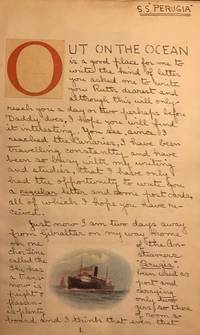
1915 ORIGINAL EXPEDITION JOURNAL AND TRAVEL SCRAPBOOK TO WEST AFRICA AND THE ISLANDS OFF THE WEST COAST FOR HIS DAUGHTER RUTHIE HANDWRITTEN AND COMPILED BY A TRUE RENAISSANCE MAN WITH THE BACKDROP OF WWI LOOMING
CHARLES WELLINGTON FURLONG
- Date published: 1915
Good+. 1915. On offer is a remarkable, original 1915 illustrated manuscript travel journal/scrapbook by the renowned Renaissance man Charles Wellington Furlong of Massachusetts lovingly created, deliciously detailed for his daughter, Ruthie. The noted trip to Madeira and the Canary Islands 'Morocco Etc. A Story' was sponsored by Harvard [from which a number of academic writings from this voyage were written including the Harvard Alumni magazine publishing an article on the expedition written by Henry Amory citing C.W. Furlong as a representative of Harper's and Dr. Erving as the ship's doctor. [Researchers and historians will no doubt understand the precariousness of the expedition given World War I served as a backdrop and ocean travel was risky even for Americans not in the War.] Both Amory and Dr. Erving are mentioned. This expedition became the basis for an article in the March 1919 issue of Harper's called "Hunting with the Lords of the Dezertas"] this charming book is fanciful; includes illustrations that include Furlong's own rather cartoon-like watercolor sketches, photographs, postcards, ephemeral pieces cut from magazines, clever puzzles and even a real, now dried, flying fish. Furlong was a fascinating individual whose life credits include: an officer of the Massachusetts Naval Brigade, partook in scientific expeditions for the US that also provided military and political intelligence, appointed to the War College during 1923-1924, created the Geographic Military Intelligence Division, produced a series of tactical field handbooks for officers on Mexico, Siberia, and Russia about the oil production facilities, named a member of the American delegation to the Paris Peace Conference, served as a military aide to President Wilson, Rome as a military attaché providing intelligence about the Middle East and the Balkans, emissary to the Sheik of Senoussi, King Faisal, Major General Sir Harry Watson, General Sir Archibald Wavell, and Field Marshall Allenby, establish a voting system in Tacona, Africa, from designing ballots and setting up polling places in remote areas and much, much more. Overall G+.; Manuscript; 12mo - over 6¾" - 7¾" tall; KEYWORDS: HISTORY OF, CHARLES WELLINGTON FURLONG, RUTHIE FURLONG, HARVARD, MADEIRA, CANARY ISLANDS, TRAVEL JOURNALS, EXPLORER, AFRICA, ISLANDS OFF WEST AFRICA, SCIENTIFIC VOYAGE, GEOGRAPHIC MILITARY INTELLIGENCE DIVISION, HARVARD UNIVERSITY, AMERICANA, HANDWRITTEN, MANUSCRIPT, DOCUMENT, LETTER, AUTOGRAPH, WRITER, HAND WRITTEN, DOCUMENTS, SIGNED, LETTERS, MANUSCRIPTS, HISTORICAL, HOLOGRAPH, WRITERS, AUTOGRAPHS, PERSONAL, MEMOIR, MEMORIAL, AMERICANA, ANTIQUITÉ, CONTRAT, VÉLIN, DOCUMENT, MANUSCRIT, PAPIER ANTIKE, BRIEF, PERGAMENT, DOKUMENT, MANUSKRIPT, PAPIER OGGETTO D'ANTIQUARIATO, ATTO, VELINA, DOCUMENTO, MANOSCRITTO, CARTA ANTIGÜEDAD, HECHO, VITELA, DOCUMENTO, MANUSCRITO, PAPEL, .
katzfinemanuscripts-6655.99-8f0af9675f7a394ae9c863a63bd53474
1919 SUPERB, SIGNIFICANT ORIGINAL MANUSCRIPT LETTER HAND WRITTEN BY A YOUNG JEWISH LEGION MEMBER, LIKELY FROM HOLLAND, DETAILING THE ASPIRATIONS AND FRUSTRATIONS OF A ZIONIST ASSIGNED TO ONE OF THE MOST UNSETTLED AND CONFLICTED POST WWI AREAS ON EARTH
1919 SUPERB, SIGNIFICANT ORIGINAL MANUSCRIPT LETTER HAND WRITTEN BY A YOUNG JEWISH LEGION MEMBER, LIKELY FROM HOLLAND, DETAILING THE ASPIRATIONS AND FRUSTRATIONS OF A ZIONIST ASSIGNED TO ONE OF THE MOST UNSETTLED AND CONFLICTED POST WWI AREAS ON EARTH
SHLOMO [a JEWISH LEGION MEMBER]
- Date published: 1919
DAMASCUS PRE SYRIA POST OTTOMAN EMPIRE. Fair. 1919. On offer is a powerful poignant letter written by an early Zionist and volunteer of the Jewish Legion in Damascus immediately after the end of WW1. The letter contains 2 double-sided sheets measuring 9' x 5.8', and an envelope measuring 5.9' x 4.9'. The envelope has no inscriptions or stamps, except a round sticker with bookseller's name - "Coles", the sheets are yellowed and torn in half at folds, but it does not affect the text, which is perfectly legible. The letter is written in Hebrew, addressed to Shimon and signed by Shlomo (Solomon). It seems from the context that they are very close friends. The first page bears the date and place: Damascus, August 20, 1919. It is also clear that the author was a Dutch Jew, who had lived in Eretz Israel for some time before joining the military. Based on the date when he joined the army (summer 1918) and other context, it can be said with high level of certainty that he was a member of the Jewish Legion. The Jewish Legion was the name of 39th through 42nd Battalions of the Royal Fusiliers in the British Army that were formed of Jewish volunteers. The formation of a Jewish Regiment was initiative of Zeev Jabotinsky and Joseph Trumpeldor promoted by John Henry Patterson. Among its members were also David Ben-Gurion, Dov Hoz, Yitzhak Ben-Zvi, Yakov Drori, Levi Eshkol, and other famous Zionist leaders, many later became members of Haganah and laid the foundation of the Israel Defence Army. The initial unit, Zion Mule Corps was formed in 1914 - 1915, in August 1917 formation of a Jewish regiment was officially announced, in spring and summer 1918 volunteers from Palestine joined 39th and 40th Battalions and started service. That's exactly when the author volunteered: "My Dear Shimon, some time ago I received your last letter, probably the first one that you wrote to me in Hebrew, and now I have a little more time and will answer to you when I am calm also in Hebrew - now I have been a soldier for over a year, but what we hoped for when we volunteered for the Army, was not realized...". There is something deeply moving in this letter full of thoughts about the future of Israel: "Until there is Jewish Army in the full sense of the word, probably a long time must pass. This moment has not come yet. Unfortunately, that's what we feel deep in our hearts. But anyway, these times have been times of very important and interesting experiments, and in this sense, this time [---] has not been lost" [p.1]; "...it is not possible yet to breathe freely, much is still missing, we can only hope that soon [...] the way out of the darkness, the uncertainty where we are now, will become clear, that it will be possible to start large, great, fruitful work, the giant work requiring all our spiritual and physical efforts, without a second thought, of each and each of us [...] to achieve our supreme goal, our people living in the Land of Israel - happy people in fertile land" [p.2]. He has acute interest in current affairs of the Zionist movement, writing about the convention of the Va'ad HaPoel HaZioni (The Action Committee) that was convening in London in the last week of August. The purpose of the congress was to work out principles of the Zionist movement in the era after the WW1 and the Balfour Declaration: "...Only when all great difficulties will be defeated, when the situation is settled. This is our heart hope! [....] the convention that will be now in London will contribute to clearing up the situation. Is this convention a sort of a congress of representatives from all countries, also from Germany and Austria? Otherwise, it is not a general convention, and it will not have any authority to make declarations in the name of all Zionism". He is particularly interested in developments in Zionist movement in Holland, mentioning names of some noted Dutch Zionists. He writes about his mood and frustrations from the army service and mentions his family: "I want for once to live like a human being, because life in the army is not life at the end. [---]. I have been sent to work at different army offices and now I am in Damascus. It is interesting to see some of the world this way, but that is not what I have volunteered to the Hebrew army for. But what to do? [----]. And I do not think that I will be able to get back to life until the next summer. I also wanted to go and see the mother, and everyone, and breathe a little different air after a while." He asks Shimon about his plans to come: "What do you think about coming to Israel? And what do they think about your preparations? [...] I have not seen any Dutch that came to Israel so far. Neither De Haan, nor Van Friesland, nor [....] I hope now to be near Jaffa and Jerusalem. What about the other that you wrote would come here". De Haan was a Dutch Jewish writer and journalist, who became interested in Judaism and Zionism, he actually moved to Israel the same year, later became close with Orthodox community and get into conflict with secular Zionists, 5 years later he was killed by Haganah members for his anti-Zionist activity. In the letter Shlomo also asks about his letters published by Handelsblad, the most important daily newspaper in Holland. This letter is an amazing historical document reflecting aspirations and frustrations of early Zionists, and their mood and concerns in the wake of the First World War and Balfour Declaration.; Manuscript; 8vo - over 7¾" - 9¾" tall; KEYWORDS: HISTORY OF; EARLY 20TH CENTURY; 1910S; WW1; FIRST WORLD WAR; GREAT WAR; MANDATORY PALESTINE; SYRIA; DAMASCUS; OCCUPIED ENEMY TERRITORY ADMINISTRATION, ARAB KINGDOM OF SYRIA, FRENCH MANDATE, STATE OF ALEPPO, STATE OF DAMASCUS, STATE OF SYRIA, ALAWITE STATE, JABAL AL-DRUZE, JEWS IN THE BRITISH ARMY; JEWISH VOLUNTEERS IN THE WW1; ZIONISM; EARLY ZIONISTS; ROYAL FUSILIERS; JEWS AND THE MILITARY; WARS; ERETZ ISRAEL; YISHUV; OCCUPIED ENEMY TERRITORY ADMINISTRATION (OETA); OETA SOUTH; BATTALIONS 39TH- 42ND OF THE ROYAL FUSILIERS; JEWISH REGIMENT IN THE BRITISH ARMY IN WW1; PALESTINIAN JEWS; IDEOLOGY OF ZIONISM; FIRST JUDEANS; THE ACTIONS COMMITTEE; VA'AD HAPOEL HAZIONI 1919 CONGRESS; DUTCH JEWRY AND ZIONISM; JACOB ISRAEL DE HAAN; ZIONIST MOVEMENT AFTER WW1; HANDWRITTEN, MANUSCRIPT, DOCUMENT, LETTER, AUTOGRAPH, WRITER, HAND WRITTEN, DOCUMENTS, SIGNED, LETTERS, MANUSCRIPTS, DIARY, DIARIES, JOURNALS, PERSONAL HISTORY, SOCIAL HISTORY, HISTORICAL, HOLOGRAPH, WRITERS, AUTOGRAPHS, PERSONAL, MEMOIR, MEMORIAL, ANTIQUITÉ, CONTRAT, VÉLIN, DOCUMENT, MANUSCRIT, PAPIER ANTIKE, BRIEF, PERGAMENT, DOKUMENT, MANUSKRIPT, PAPIER OGGETTO D'ANTIQUARIATO, ATTO, VELINA, DOCUMENTO, MANOSCRITTO, CARTA ANTIGÜEDAD, HECHO, VITELA, DOCUMENTO, MANUSCRITO, PAPEL .
katzfinemanuscripts-6855.99-9724daa5019242ac8e0298488af453d7
1919 ORIGINAL, MASSIVE MANUSCRIPT DIARY OF A YOUNG MAN, ALREADY AN OLD SALT, WHO PINES FOR A SHIP AFTER SERVING IN THE NAVY AND WHO ONE DAY GOES ON TO WRITE ABOUT THE SEA
1919 ORIGINAL, MASSIVE MANUSCRIPT DIARY OF A YOUNG MAN, ALREADY AN OLD SALT, WHO PINES FOR A SHIP AFTER SERVING IN THE NAVY AND WHO ONE DAY GOES ON TO WRITE ABOUT THE SEA
ARTHUR GORDON aka ARTHUR SHIRT
- Date published: 1919
Good. 1919. On offer is a super, fascinating 14 x 12 inch 300 page diary and manuscript relic of post-World War I adventures and nautical life handwritten by Arthur Gordon while he served as Third Mate on the S.S. Rheem dated Nov, 4 1919 through to May 8, 1920. Elevating this diary of life aboard a working ship en route to Central America is that this wonderful account is written by an aspiring author whose keen eye and gift for narrative are revealed early in the journal. [Gordon would later write stories on naval, sea, and air themes, the Merchant Marine and books on sea history such as "The Years of Peril" an account of the experiences of Mobil Co. ships during WW II.] Here is a snippet: Thursday 13, 1919 On SS W.S. Rheem, Bayonne N.J. This morning I had a strong prediction that I would find work. I took along everything I would need in case I did and it was a fortunate thing for at nine thirty I was on my way to the New York offices of Walker and Daly. They wanted a Third Mate I was a Third Mate and wanted a job: nothing could be simpler. I signed the articles then and there without seeing the ship or knowing where it was bound. I went to the club, packed my trunk and found my way to the ship. We are leaving for some Mexican Port at nine o'clock tomorrow morning. November 18, 1919 SS W.S. Rheem Ran into a north-easter last night and we were forced to lay up to the wind and ride it out. it was a mean black watch that I stood. This morning's watch was as bad. High rough seas and blinding rain storms makes four hours seem like days. When I came below at twelve and has a chance to look at my hands I thought that my fingers resembled pale sweet pickles so puckered up they were with rain. November 20, 1919 The actions of the officers with whom I am to become familiar lead me to believe the they will be fair square and congenial. The captain Harry Jensen by name of Danish and reminds me Kristens father. He is gruff and outspoken but has good sound judgment and is gifted with certain considerations which show him to be well aquatinted with and willing to deal easily with the fallibilities of the human race. Mr Gullickensen the Chief Mate a Norwegian, is of mild and pleasing disposition he has very large feet and wears blue suspenders (although I'm sure he doesn't know it) like King Albert of Belgium . The engineers are separated from the Mates and i do not know any of them excepting the Chief and he appears to be quite friendly. The radio operator is English but hails from Lyann Mass, and he and i at once joined forces, to defend Massachusetts should anything disparaging be mentioned of her. The wireless man goes by the name of "Sparks "aboard ship in fact all radio operators are dubbed "Sparks" This fact leads those who are not familiar with it to make the amusing error that Mr Green a passenger of ours made when after a few days out at sea introduced himself and said "My name is Green Mr Sparks and I 'am glad to know you'. This caused much merriment and led Sparks to say it was a common occurrence." An old salt Gordon served in the Navy on the USS Washington and wanted to go back to sea. The SS W.S. Rheem travels to Mexico, and Panama and others ports. This particular diary is incredibly detailed: his description of shipboard life on various ships, the times he spent at the Panama Canal and the Gulf of Mexico, ports like Tampico, Mata Redona Mexico Colon Panama, Key West, Cape Hatteras but Gordon's description of Mexico and Panama are wonderfully intimate and detailed covering numerous pages. Adding further breadth to this journal are two loose pages from a scrapbook with photos depicting different ships, five large photos of a crewman and one of Gordon. There five pages of hand drawn maps showing the routes of the ship, an original play he wrote, also some literary criticism, comments on books, authors (very fond of Dickens), ideas on writing and there is a section titled "Odd Jobs" thoughts and other ephemeral pieces such as a letter he received from Travel Magazine regarding a submission he sent them titled the "Mexican Church" using his pen name Arthur G. Shirt. Here are some more snippets: "There are a few ex-service men in the crew as evidenced by the remnants of the uniforms they used to wear. There is one lad who appears on deck with complete doughboy outfit, with olive - drab shirt trousers and leggings. Dickens says in his preface to David Copperfield "But like many fond parents i have in my heart of hearts a favorite child. And his name is" David Copperfield "and David Copperfield has already become my favorite child of fiction. At present I am absolutely fascinated with the story and with the manner in which it is told. Characters were never so real as the characters surrounding David Copperfield: and i carry them In my mind and when i am on the bridge, I reenact their doings and re-say their sayings. Thanksgiving Day 24,1919 SS W.S. Rheem We first saw the coast of Mexico in the early morning of last Sunday and shortly after seeing faint dim outline we were at anchor just inside the bar of Tampico awaiting a berth at the oil docks. Sparks and I went ashore after dinner Sunday noon. We hailed and were rowed ashore in a n extremely small boat propelled by a remarkably small boy and two immense oars. The combination was so ridiculous and was so unfair to the small boy that i was tempted to row myself but was dissuaded by the oil and grease about the working area of the craft. We waited at the station until two o'clock for the one - thirty train and set foot in Tampicos, Mexico twenty miles later the stretch of county Penucos River between the ship at La Bana and the city is nothing but a mud flat and the this season of the year actively muddy the houses are built Malay style on stacks and the garden walk was a twelve inch plank also on stacks. The people we thought were as oily and as muddy as their city and river. They dress loosely with broad- rimmed Sombreros. Their shirts are tail - less and are not tucked in and their trousers rival a sailors in their ability to flap. If they have shoes they rarely wear them, but instead a sandal affair bound about the foot in a careless manner. Our Bosun tells us of the visit of a Nicaraguan Admiral to an American Man -O - War. He wore broad cloth, had gold stripes half way up his arms, heavy gold epaulets: gold collar: bemedalled chest peaked cap and dangling sword a noble figure indeed - but from beneath the trim of his striped trousers there peeped ten ugly dirty toes- He was barefooted! There seems to be a preponderance of men in Tampico a great many urchins apparently uncared for - and what women there were, were ugly- in my eyes at least. The young men I thought were attractive with their dark skin and hair, and their flashing dark eyes. The policemen such as they were , were disgraceful. We watched them line up at night and all though they were in military formation they were shelling peanuts and smoking cigarettes. I received one impression from exchanging glances with the Mexicans I passed and I left Tampico with that impression firmly in my mind: That these people are not to be trusted. The next night I was called upon to be the interpreter between the sailors and the Mexican customs official who came on board with the pilot and did not leave until we finally headed for sea. The bone of contention was that the sailors were bringing liquor aboard and the customs official did not approve of it. The sailors advanced several arguments and I realized than to the best of my ability to the Mexican he was obdurate and I had really given up the fight when he said drawing e aside "If you give me three dollars I will not see" The old Grafter after money eh? I told the sailors what he wanted and let them to finish the deal which i learned later was arranged to the satisfaction of both parties. Feb.13,1919 SS WS Rheem At Tampico Mexico. Unusual excitement was occasioned this evening by the ugly disposition of the Mexican Customs Official He was dissatisfied with the bunk which the Steward had assigned to him and was in no way delicate about making his satisfaction known. The altercation came to climax when he official reinforced by three of his fiends form shore faced the Captain and demand better quarters. The Capt took the opportunity to inform the Customs Official that Harry Jensen was Captain of this ship. The manner in which Harry Jensen made this clear alarmed one of the friends and he pulled a gun." BIO NOTES: Arthur Gordon had a long career at sea. He would serve aboard the USS Oceanographer for four years on the US Coast Survey. Later after WW II he would write the book "The Years of Peril" the World War II story of Mobil men and ships by Arthur Gordon. Besides serving in WWI and WWII he traveled extensively as a Merchant Marine Officer, and was employed in the tourist industry. After WWI Gordon made two trips around the world and into the Amazon. Gordon also attended Bard College, and NYU finally earning a Master's degree. In 1949 he was teaching classes in writing fiction. He was listed as a Navy Commander in the reserves in 1949 as well. At that time his full time employment was as a Freelance Writer. He published short stories in Argosy and Maclean's Magazine sometimes using the pen name "Arthur Shirt". The spine is missing, cover boards show heavy wear front cover board hinge is weak but holding rear is the same. Interior is in good. Overall G. NOTE: WE LIST HIS RECENTLY REDISCOVERED 1928 JOURNAL SEPERATELY. SELLER ID OOO9075.; Manuscript; Folio - over 12" - 15" tall; KEYWORDS: HISTORY OF, ARTHUR GORDON, STEAMSHIP, MEXICO, ARTHUR SHIRT, PANAMA, CENTRAL AMERICAN, SOUTH AMERICA, S.S. RHEEM, PANAMA CANAL, GULF OF MEXICO, TAMPICO, MATA REDONA, MEXICO, COLON, PANAMA, KEY WEST, CAPE HATTERAS, WWI, WWII, COASTAL SURVEY, OCEANOGRAPHIC SOCIETY, THE YEARS OF PERIL, WORLD WAR II, MOBIL, MERCHANT MARINE, BARD COLLEGE, NYU, SS W.S. RHEEM, MARINE, NAUTICAL, NAVAL, USN, UNITED STATES NAVY, NAVIGATION, LIFE AT SEA, LIFE ABOARD SHIP, AMERICANA, HANDWRITTEN, MANUSCRIPT, DOCUMENT, LETTER, AUTOGRAPH, WRITER, HAND WRITTEN, DOCUMENTS, SIGNED, LETTERS, MANUSCRIPTS, HISTORICAL, HOLOGRAPH, WRITERS, AUTOGRAPHS, PERSONAL, MEMOIR, MEMORIAL, AMERICANA, ANTIQUITÉ, CONTRAT, VÉLIN, DOCUMENT, MANUSCRIT, PAPIER ANTIKE, BRIEF, PERGAMENT, DOKUMENT, MANUSKRIPT, PAPIER OGGETTO D'ANTIQUARIATO, ATTO, VELINA, DOCUMENTO, MANOSCRITTO, CARTA ANTIGÜEDAD, HECHO, VITELA, DOCUMENTO, MANUSCRITO, PAPEL, .
katzfinemanuscripts-6955.99-06671797f3343aa1126c1adca2d14b43
 Login via Biblio